
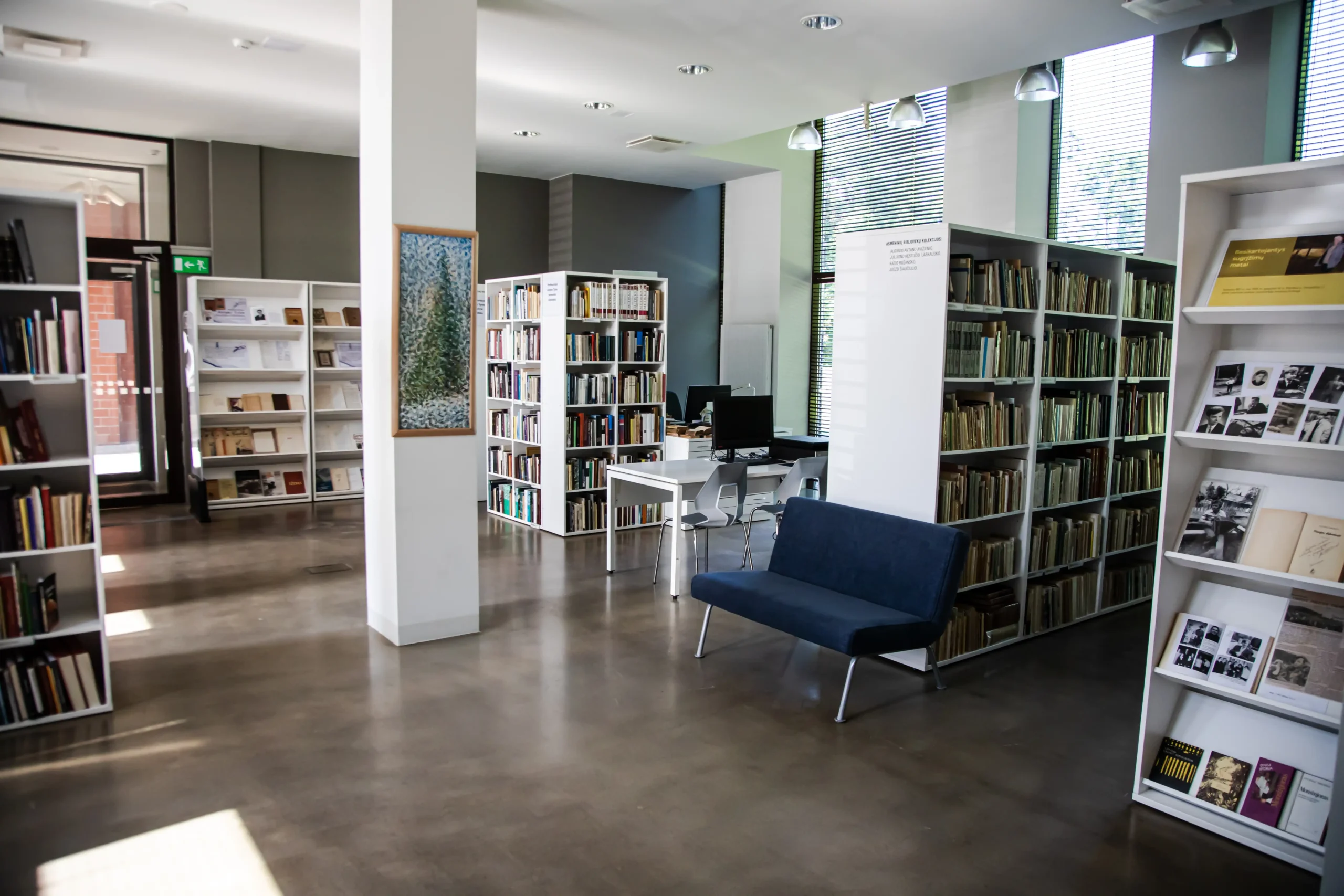
The Anykščiai L. and S. Didžiuliai Public Library's local history fund collects a personal archive: official documents, manuscripts, and memoirs testifying to the lives and activities of prominent Anykščiai residents - those who originated from the Anykščiai region, lived or are living here, and left prominent traces in the cultural landscape. Summarizing and presenting these documents, supplementing and clarifying knowledge through personal communication with Anykščiai residents, the library's local history researchers prepare personal reviews and publish them in periodicals and on Internet portals.
The personal reviews published in this section of the website are divided into several areas of activity, as if bringing together famous Anykščiai residents into small communities, where their activities that make the Anykščiai region famous are best revealed.
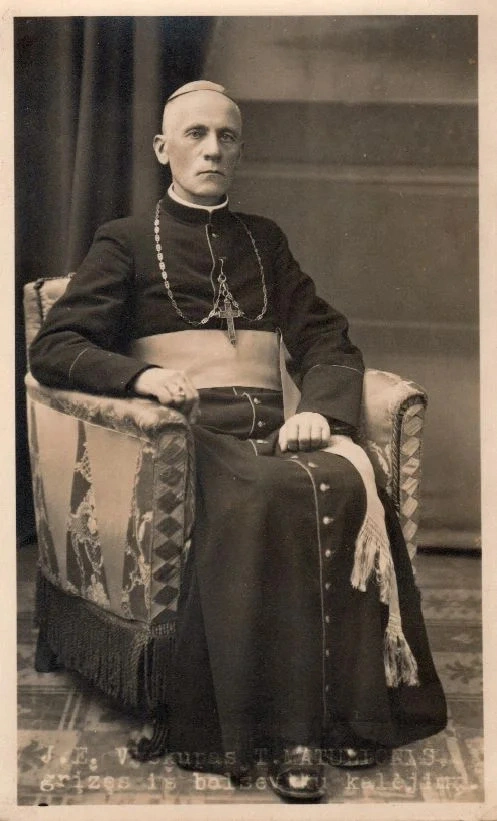
Priest, archbishop, defender of the faith and martyr, political prisoner, blessed TEOFILIUS MATULIONIS was born on June 22, 1873 (date of birth according to the new calendar – July 4, 1873) in the village of Kudoriškis, Alanta parish (now Anykščiai district), into a family of wealthy farmers.
In 1880, after his parents moved, he grew up in the village of Purviniškės (Daugailių parish, Utena district), often spending time in Žibėčiai (Molėtai district) with his grandparents. He studied at home, at the Antalieptės (Zarasų district) primary school, and in 1887–1892 at the Dinaburgos (now Daugavpils, Latvia) real gymnasium. After graduating from it and not learning Latin, he was not accepted into the Vilnius seminary, so in 1892–1900, with a break in 1893–1895, when he doubted his vocation, he studied at the Mogilev Archdiocese seminary in St. Petersburg (Russia).
On March 4, 1900, in St. Petersburg, the suffragan bishop of the Archdiocese of Mogilev, Karolis Antanas Nedzialkovskis, ordained T. Matulionis a priest. He celebrated his first Holy Mass in the Church of St. Anthony of Padua in Daugailiai (Utena district).
Appointed on June 26, 1900, in 1900–1901 T. Matulionis served as a vicar in the Catholic parish of Varakliani (Latvia). On November 8, 1901, he was appointed to Bikava (Bychov, Mogilev region, Belarus) to temporarily serve as a pastor. On February 9, 1902, he was dismissed from the position of vicar of Varakliani parish altogether and in 1902–1908 he was the pastor of the Catholic parish of the Immaculate Conception of the Blessed Virgin Mary in Bikava. He rebuilt the Bikava church and maintained very close ties with the families of the parishioners.
Transferred on September 17, 1908, he briefly served as pastor of Varaklianai parish in September–October 1908, until he was returned as pastor to Bikava on October 20, 1908, where he continued to serve from 1908–1910.
For baptizing a child from a mixed Catholic and Orthodox family, on June 30, 1910, he was sentenced to a year in a penal servitude for priests at St. Catherine's Church in St. Petersburg.
From 1910 to 1929, T. Matulionis lived in St. Petersburg (Russia) and served in Catholic parishes. On November 26, 1910, he was appointed vicar of St. Catherine's Church in St. Petersburg, from 1911 to 1914, he was also the administrator of the chapel in the suburban village of Aleksandrovsk beyond the Neva Gates, the chairman of the construction committee for the Church of the Sacred Heart of Jesus being built there, and was constantly sent to serve in the church under construction. After the construction of that church was completed, from 1914 to 1923, he was the pastor of the Church of the Sacred Heart of Jesus beyond the Neva Gates.
When the Bolsheviks began to persecute priests and close churches, T. Matulionis refused to hand over church property and rent out the premises, and therefore on March 10, 1923, he was arrested in Moscow (Russia). On March 21–26, together with the bishop and 15 other priests, he was convicted and sentenced to three years in prison for hostility to the Soviet government.
Held in Moscow's Sokolniki and Lefortovo prisons for almost two years, in January 1925 he was amnestied and released, returned to St. Petersburg and continued to serve as pastor of the Sacred Heart of Jesus parish from 1925 to 1929. With no Catholic priests left in St. Petersburg and other cities, he simultaneously took care of the affairs of seven churches in the city, as well as the Catholic parishes of other Russian cities - Pskov and Novgorod.
On December 8, 1928, Pope Pius XI appointed Father T. Matulionis as titular bishop of Matrega and suffragan bishop of Mogilev (Belarus). On February 9, 1929, Bishop Antanas Maleckis secretly consecrated T. Matulionis as bishop in the Kirilovskaya Chapel of the Church of the Blessed Virgin Mary in Leningrad (now St. Petersburg, Russia).
Soviet security repeatedly tried to recruit him, and on November 25, 1929, he was arrested and accused of espionage and leading an underground nationalist Latvian school. On September 13, 1930, the United State Political Board sentenced T. Matulionis to 10 years of hard labor, and in December he was sent to serve his sentence to the Solovki Islands in the White Sea (Russia). For organizing a camp commune, on July 5, 1932, he was arrested and taken to prison on July 22, and on May 27, 1933, he was tried again and received one year of solitary confinement - he was assigned to build a log road in a swamp.
In September 1933, through the efforts of the Lithuanian government, T. Matulionis was exchanged for communists imprisoned in Lithuania and, despite his desire to remain at his place of assignment in St. Petersburg, he returned to Lithuania on October 19, 1933, together with ten Lithuanian priests.
In 1933–1943, T. Matulionis lived intermittently in a Benedictine nunnery in Kaunas, assisting Kaunas Archbishop Juozapas Skvireckas in pastoral work. In 1934, he visited Pope Pius XI in Rome, where he was especially honored as a martyr. Later, Pope Pius XI said about Bishop Teofiliai: „Glory to the Lithuanian nation, which gave us such a hero.“ In 1934–1936, T. Matulionis, together with priest Dominikas Mikšys, traveled to the United States of America, where he visited Lithuanian parishes. On his way back, he visited Egypt and Jerusalem, and met with Pope Pius XI once again.
Appointed in the summer of 1936, from 1936 to 1943, T. Matulionis was the rector of the St. Archangel Michael (Garland) Church in Kaunas and in 1938 introduced permanent adoration of the Blessed Sacrament in this church. In May–June 1940, he served as the chief chaplain of the army – he was the last chaplain before the Soviet occupation. With the outbreak of World War II, T. Matulionis organized priestly missions to the German-occupied Eastern lands.
After the death of Bishop Juozapas Kukta of Kaišiadorys, on January 9, 1943, T. Matulionis was appointed Bishop of Kaišiadorys, and his solemn investiture took place on May 21, 1943. He urged priests to solemnly celebrate the feast of the Sacred Heart of Jesus, to take care of sobriety, to mobilize laypeople for catechization work, and spoke out strongly against abortions and drunkenness as a desecration of marriage.
At the beginning of the second Soviet occupation, the bishop addressed a memorandum to the Lithuanian Council of Commissars, demanding that the rights of believers not be restricted, that young people not be forced to join godless organizations, and that priests not be persecuted.
In 1944–1946, he did not hide his political views – he advocated the restoration of an independent Republic of Lithuania. On September 5–6, 1944, he organized a congress of Lithuanian bishops in Ukmergė, where the issues of further activities of the Kaunas Theological Seminary and religious education in churches were discussed; he organized another congress of bishops in Kaunas in March 1946.
At the initiative of T. Matulionis, priests began to write mass applications to the Ministry of Education to allow them to teach religion in schools, and they themselves taught children in churches. The bishop ordered priests not to announce Soviet rallies, not to urge them to fulfill the obligations assigned to them by the government, and threatened priests who collaborated with the government with the suspension of their priesthood. He refused to sign a letter of thanks to Stalin for the “liberation of Lithuania”, and did not agree to address the partisans and urge them to stop the fight.
On December 18, 1946, T. Matulionis was arrested again, interrogated for several months in Vilnius for anti-Soviet activities, until on September 27, 1947, by a Special Meeting in Moscow (Russia) he was sentenced to 7 years in prison “for cooperation with an anti-Soviet nationalist gang and anti-Soviet agitation”, and all his property was confiscated. In 1947–1948, he was imprisoned in Orsha, at a prisoner transfer point, where he was mostly treated in a hospital, and from April 25, 1948, he was taken to Vladimir Prison No. 2, a special regime prison, where he served his sentence in December 1953. Despite T. Matulionis’ requests to be allowed to return to Lithuania, he was not released, and on May 28, 1954, was transferred to the special purpose home for the disabled in Zubovo Polyana (Mordovia, Russia).
After long and repeated requests to be allowed to return to Lithuania, only on May 4, 1956, the tortured Bishop T. Matulionis regained his freedom and returned to Lithuania. Having not received permission from the authorities to govern the diocese and already in poor health, he settled in Birštonas with his friend and assistant pastor Jonas Jonis. On December 23, 1956, he wrote and distributed a pastoral letter to the faithful, in which he declared 1957 a year of sobriety and encouraged them to live soberly.
On November 14, 1957, he secretly took over the administration of the Kaišiadorys diocese from Canon J. Stankevičius. On December 25, 1957, in an apartment in Birštonas, T. Matulionis secretly consecrated Honorary Canon Vincentas Sladkevičius as bishop, and he was appointed assistant to the bishop of Kaišiadorys.
As a result, on October 17, 1958, by decision of the Soviet authorities, the bishop was removed from all duties, deported, and forcibly settled in Šeduva (Radviliškis district).
On May 31, 1960, Pope John XXIII granted T. Matulionis the title of Bishop of the Apostolic See (Episcopi Pontificio Solio adstantis). On February 9, 1962, Pope John XXIII granted the personal title of Archbishop to Bishop Teofilis Matulionis of Kaišiadorys “for his commendable steadfastness in carrying out the duties of a good shepherd.”.
He died on August 20, 1962 in Šeduva (Radviliškis district) after a search by security officers and a mysterious drug injection. He was buried in the crypt of the Transfiguration Cathedral in Kaišiadorys next to Bishop Juozapas Kukta.
In order to recognize Archbishop T. Matulionis as a martyr and Blessed of the Church, the cause of his beatification was initiated in 1989 under the care of Prelate Stanislovas Kiškis. In 1990, he was granted the title of Servant of God. In 2008, the documents of the beatification cause were completed and submitted to the Congregation for the Causes of Saints in Rome. On December 1, 2016, Pope Francis authorized the Congregation for the Causes of Saints to issue a decree recognizing the martyrdom of the Servant of God Archbishop T. Matulionis, thus opening the way for his beatification. The Lithuanian bishops declared 2017 the Year of Archbishop Teofilius Matulionis.
On 25 June 2017, T. Matulionis was declared Blessed after the beatification ceremonies held in Vilnius. From now on, the Day of Blessed Theophilus will be commemorated annually in Lithuanian Catholic churches on 14 June. He is the second Lithuanian (after Bishop Jurgis Matulaitis, 1987) to be Blessed, and the first whose beatification was held in Lithuania. The beatification ceremonies of T. Matulionis set a Lithuanian record – the largest number of clergymen attended the service, about 600 of whom gathered in Vilnius.
The remains of T. Matulionis, after his beatification, have been transferred to a special relic sarcophagus since June 2017, which is located in the altar of the right chapel of Kaišiadorys Cathedral. The canonical painting of Blessed T. Matulionis (author – artist Zbigniew Gierczak, Krakow, Poland, 2017) is also installed in this altar. This portrait painting of T. Matulionis is used in ceremonies and churches.
As a Catholic priest who suffered from repression by the Soviet government, T. Matulionis is included in the martyrology of the Catholic Church of the USSR.
He was awarded the Order of the Cross of Vytis (posthumously, 2006), the Cross of the Rescuer of Drowning People (posthumously, 2003), and was awarded the title of Honorary Citizen of the Kaišiadorys District Municipality (posthumously, 2017).
Books published about the life of T. Matulionis:
A documentary film by Dalius Ramanauskas "The Blessed Martyr. A Look at Archbishop T. Matulionis" (1999) was created about T. Matulionis.
The life and activities of T. Matulionis, as well as the documents of his beatification, are presented on websites dedicated to him. www.matulionis.info and www.teofilius.lt.