1. Trakinės Cemetery and Battle
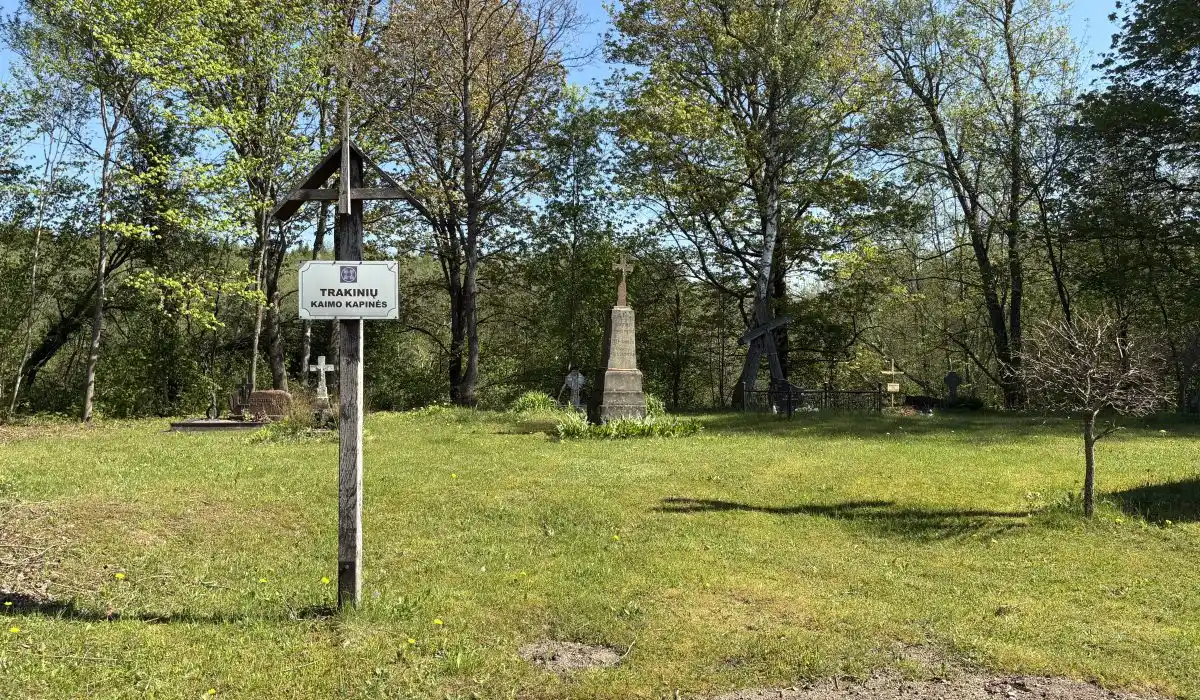
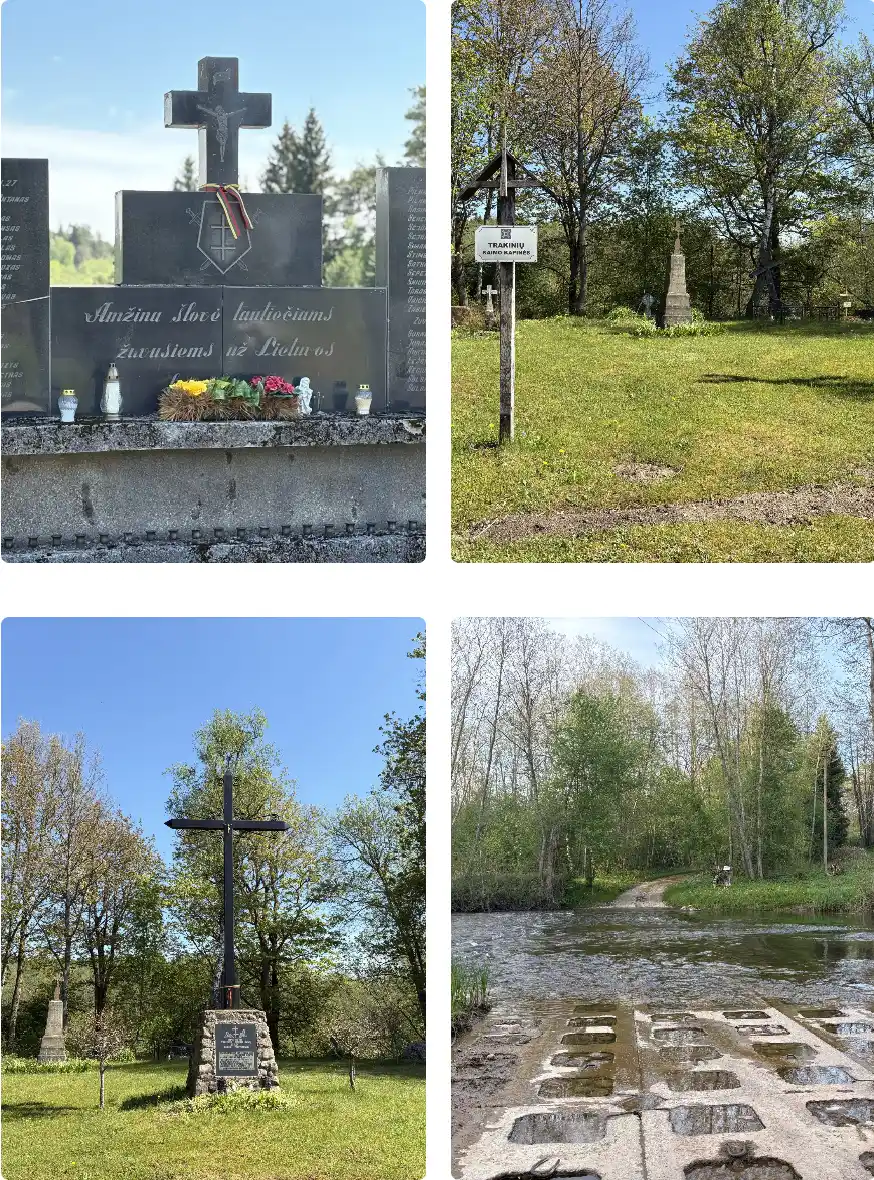
It is not easy to get to this cemetery - you will have to wade across the Virinta River. But do not despair: it is a unique experience. There are individual tombstones and monuments here, and in their center - a monument erected at the beginning of the 21st century to the partisans who died here in 1945.
It was on June 27, 1945, in the village of Trakinai that the largest battles in the Anykščiai region took place between Lithuanian partisans and the forces of the Soviet Union. The unit of more than a hundred partisans was led by the commander Alfonsas Bagdonas-Aras (1912–1945), who was famous for his fearless attacks. After half a day of fighting, some of the partisans retreated, and those who fell into ambushes were killed. A total of 36 fighters were killed, the enemy's losses are unknown. During the fighting, part of the village of Trakinai burned down.
The fallen fighters, including the commander and his two brothers, were scorned and later buried in a ravine near Kurkliai. Only in 1989 were their remains solemnly reburied in the new cemetery in Kurkliai. Today, a candle can be lit there in memory of the fighters who died in Trakinai.
For some time, the memory of the Aro unit partisans was cherished by the historical festival "Trakinės partisans", held every summer near the Trakinės cemetery.
2. The Kuktos Brothers – Lithuanian Creators
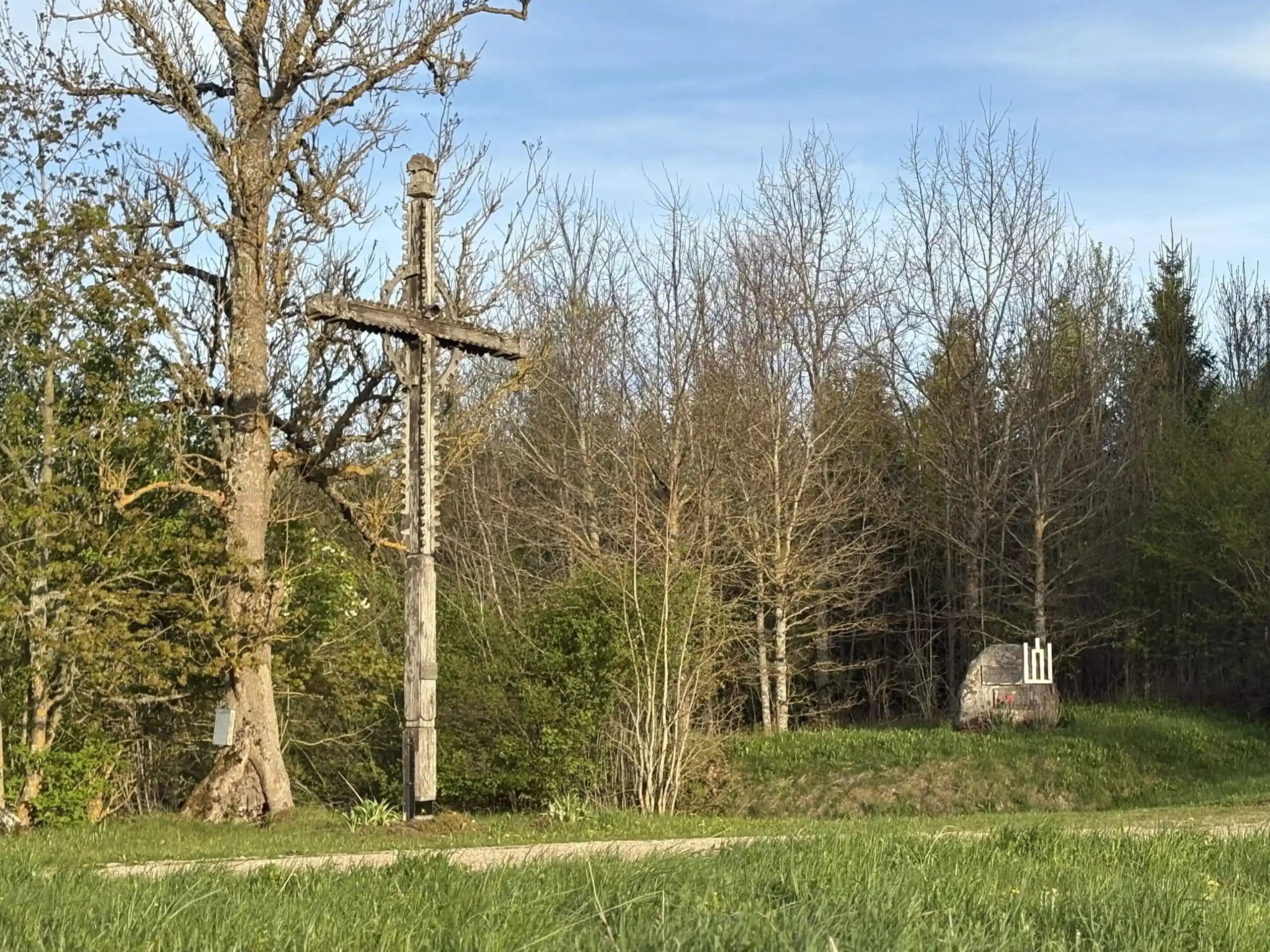
At the former village intersection of Trakinai Street, a cross and a stone dedicated to the village's memory stand today. Trakinai is a star village that has produced many famous personalities for Lithuania. Let's stop at one of the most prominent families that matured here - the Kukts.
Two brothers grew up near this intersection – Juozapas (1873–1942) and Martynas (1875–1956) Kuktos. Both of them were extremely active leaders of the Lithuanian national movement. Juozapas – a priest, the first bishop of Kaišiadorys, a promoter of Lithuanian identity in Vilnius, one of the organizers and participants of the Great Vilnius Seimas. Martynas – a printer and businessman, who printed Lithuanian newspapers and books in Vilnius until the First World War. It was he who, in 1918, was the first to duplicate the Act of Independence of Lithuania, proclaimed on February 16.
At the beginning of the 20th century, the Kuktos brothers knew the most important Lithuanian politicians and cultural figures, and most importantly, both significantly contributed to the creation of the modern Lithuanian state.
Their nephew Petras Kukta-Girininkas (1920–1949) became a prominent partisan. He printed partisan newspapers in bunkers – perhaps inspired by the example of his uncles’ lives. In 1949 Petras was killed in battle.
And this is just one story, not yet fully told, of a family that grew up in Trakiniei.
3. Monument to Uncle Volunteer
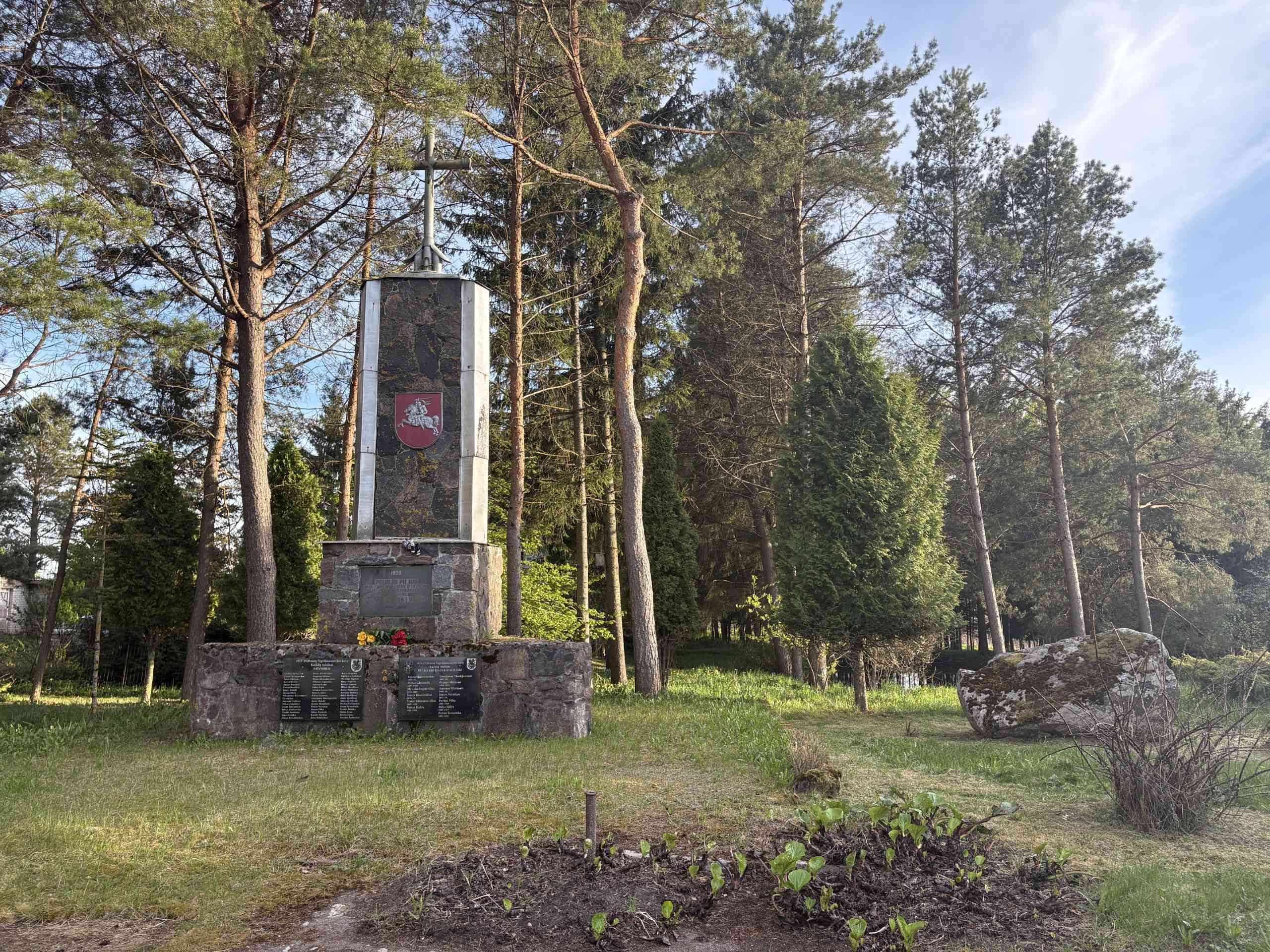
Driving through the village of Didžiakaimis, you will unexpectedly see an impressive monument surrounded by pine trees. It invites you to stop and remember an important episode in Lithuanian history. It is here that on May 18–19, 1919, the Lithuanian army broke through the ranks of the Bolsheviks. This was a significant and successful part of the Lithuanian army's offensive in the Kurkliai area, after which the Soviet Russian forces were completely driven out of the country by the end of August.
The Battle of Didžiakaimis also had its own hero – the Lithuanian Jew Simas Vasermanas, whose courage and determination became living testimony to how the fate of the state was decided. Here is how his feat and that of his comrades are remembered:
„"On May 18, 1919, after the capture of the village of Didžiakaimis, a company platoon was sent to reconnoiter in the direction of the highway. Company commander Juozas Kazlauskas, soldiers Jurgis Malinauskas, Zenonas Miklušis and Simas Vasermanas, seeing enemy artillery fleeing from Kurkliai to the highway, rushed to the left to cut off its path and began firing from rifles. The enemy, covering the artillery, opened heavy fire, wanting to save it. The listed soldiers, seeing that the enemy artillery could escape, attacked it on their own initiative, shouting "Valios". Thanks to this, one new cannon, three boxes of ammunition on six wheels, a lot of cannon cartridges, horses with harnesses and saddles were taken from the enemy."„
The monument visible today was erected in 1992 at the initiative of Jonas Pilka, who lived here. In this way, he wanted to immortalize his uncle, soldier Povilas Pilkas, and all Lithuanian volunteers who stood up to defend the newly born state. Over time, this monument became a symbol of all the battles against the Bolsheviks that took place in the vicinity of Didžiakaimis in 1919.
Stop here for a moment. Perhaps Jonas Pilka's example will inspire you too – to preserve memory, tell stories, and create your own signs for Lithuania.
4. The Royals and the "Gates of the Past"„
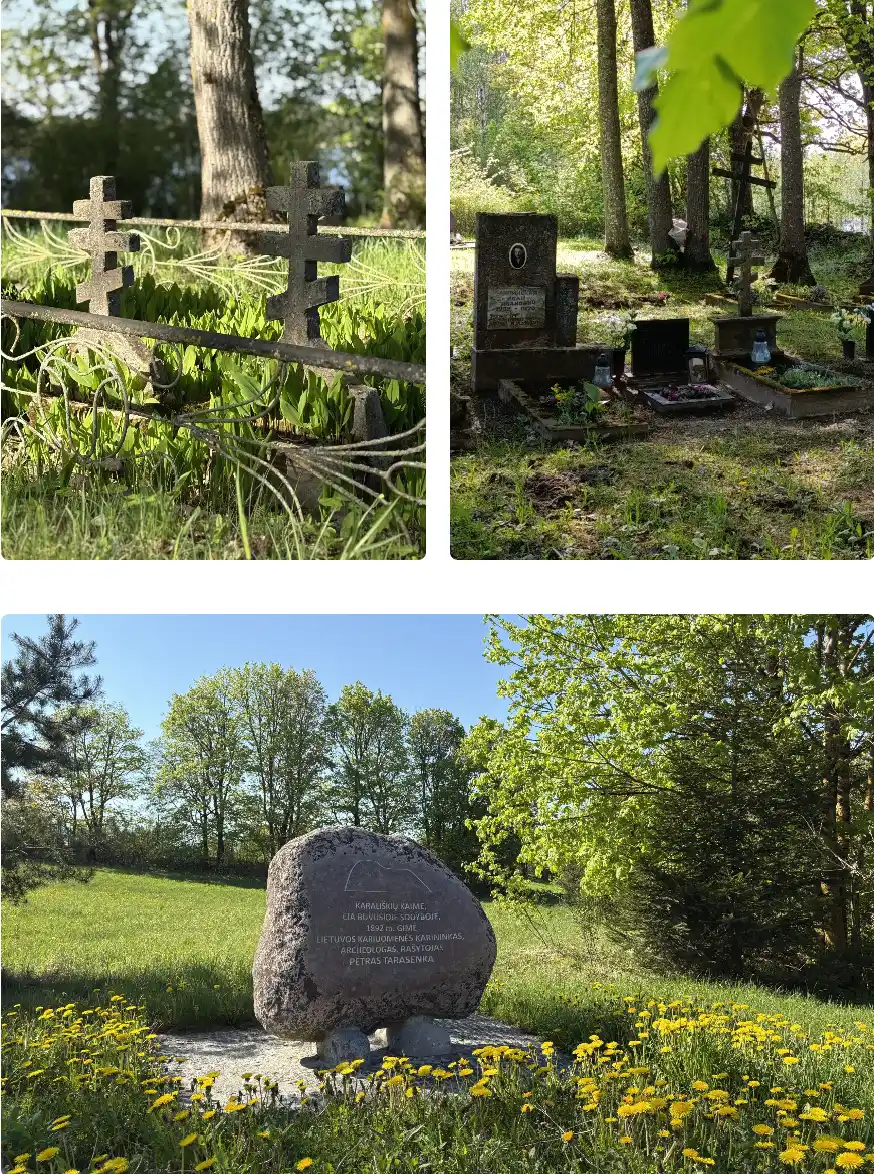
The picturesque village of Karališkės, located on the outskirts of the Kurkliai eldership, preserves two important memories. The first is the Old Believers and Orthodox community that once lived here, the presence of which is still evidenced by the surviving cemeteries. The second is Petras Tarasenka (1893–1962), a prominent and versatile personality: defender of Lithuania, officer, archaeologist, and museum worker.
Gifted with many talents, Tarasenka distinguished himself in the battles for Independence - for his bravery he was awarded the Order of the Vytis Cross, 1st degree. However, his service to Lithuania did not end with a weapon in his hands. The officer turned to archeology with a special passion: he studied prehistoric monuments, mounds and old settlements. One of the objects he studied was the Varguliai mound near Karališkės.
However, Tarasenka became most widely known as a writer who was able to tell the ancient history of Lithuania in a lively, figurative language. His books "Gateway to the Past", "In the Temple of Thunder", "Escape" became a real source of inspiration for many archaeologists and historical researchers. Many of them have admitted that it was these books, which were extremely popular at the time, that encouraged them to choose the path to learning about Lithuania's past.
Try it yourself. You might not notice how, inspired by Tarasenko's spirit, you will go on hikes in search of the signs left by your ancestors and, who knows, you will discover the unknown treasures of our history.
5. Stasys Yla and sister Marija Augusta
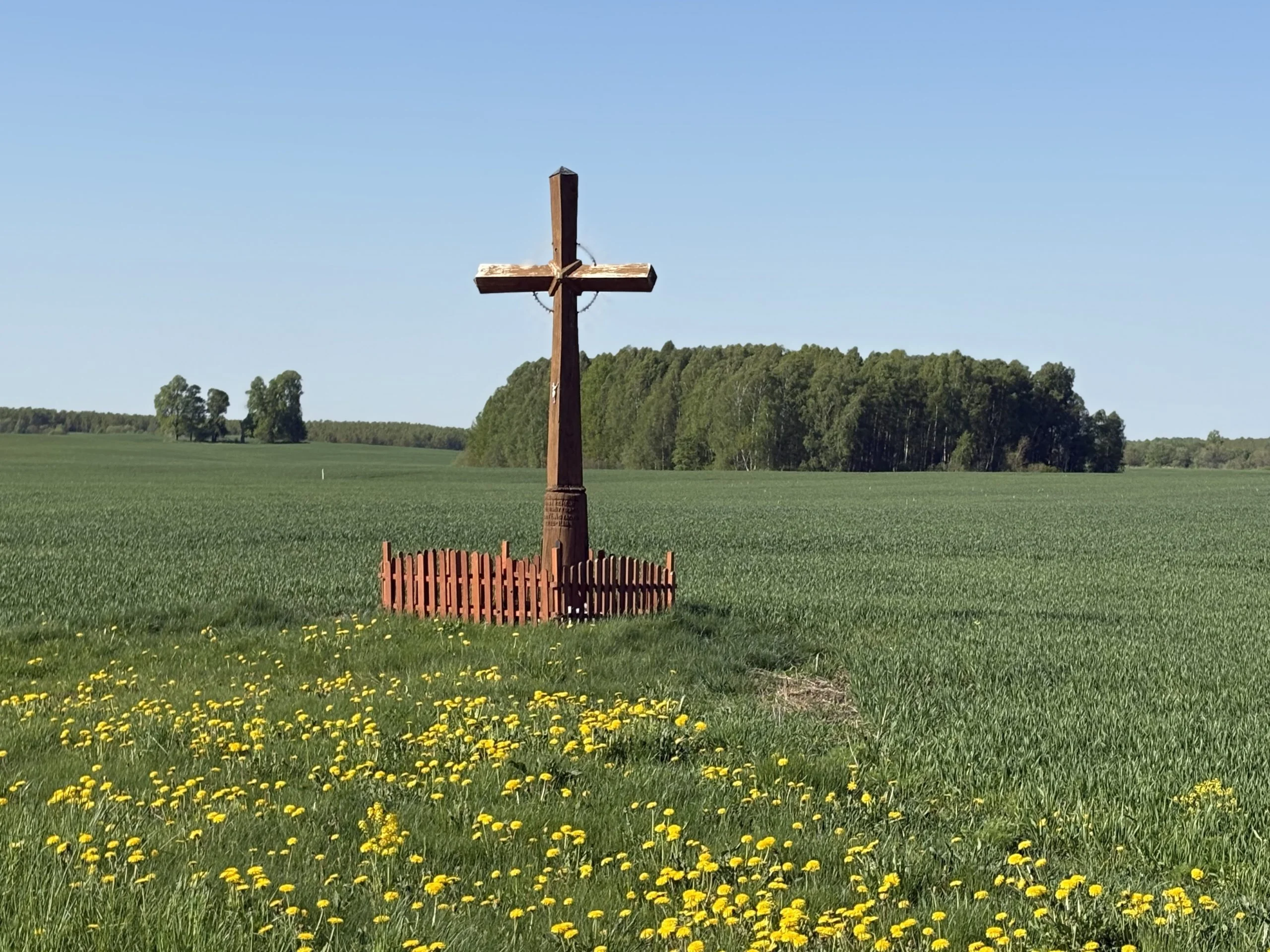
In the village of Luciūnai, next to the main road, stands a cross marking the birthplace of priest, writer, educator, and Nazi political prisoner Stasys Yla (1908–1983). This is the place where the path of a man who combined depth of thought and tireless activity began. Yla's spiritual and intellectual footprint transcended the boundaries of time.
The diversity of his works and activities is astonishing even today: from philosophical reflections to sensitive books about the psychology of adolescence, from active work in the Federation of Future Leaders to the promotion of Scouting. It is no exaggeration to say that he was one of the most prominent and active personalities of the 20th century in Lithuania and among Lithuanians in the United States.
Yla's name is inseparable from the courage to bear witness to the truth. In his memoirs "People and Beasts", he left a vivid, painful testimony about the test of humanity experienced in the Stutthof concentration camp under inhuman conditions. The study "Communism in Lithuania" still speaks to the reader today, inviting not only to read, but also to think.
Yla's cousin Apolonija Sereikytė – Sister Marija Augusta (1907–2002) – also grew up in this region, in the nearby village of Buria. An active public figure, journalist, and activist in women's organizations, her life also testified to a quiet but steadfast path of service to humanity.
Stop in the village of Luciūnai. Look at the fields, listen to the silence and let this place speak.
6. Teachers Shibailas and their school
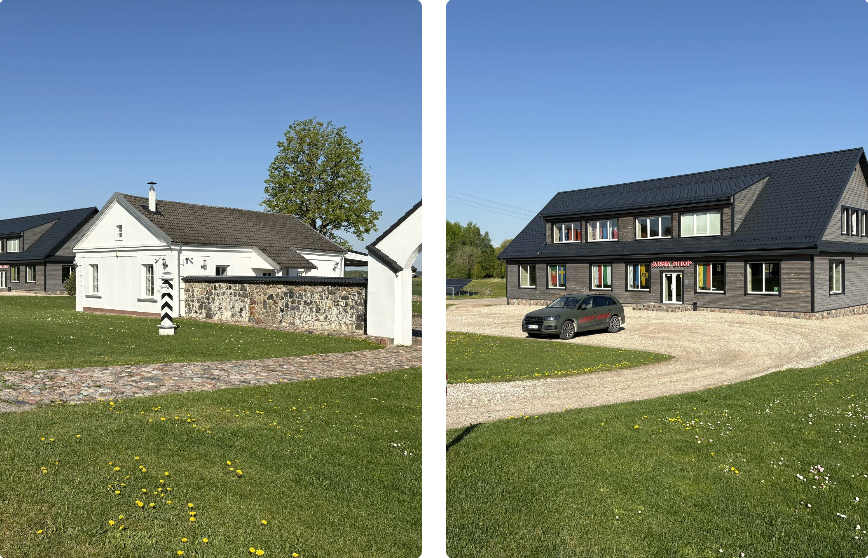
In Saškūniškis, next to the historic Zarasai-Kaunas highway, also known as the Petersburg-Warsaw tract, a former elementary school has stood since 1936. At that time, such schools marked important changes in Lithuanian education and symbolized faith in the future.
Until 1940, the famous teachers Juozas (1905–1953) and Ona (1902–1993) Šibailos worked at this school. Juozas was distinguished by his active social activities – he was a shooter, a member of the Young Lithuanians, and a scout, while Ona earned the respect of the community for her teaching skills, patience, and devotion to children. The two of them became real celebrities in these areas, bearers of light for the children of the village.
However, the Soviet occupation mercilessly changed the fate of this teacher couple. Ona and her children were exiled to Siberia, and Juozas chose the path of resistance in 1944 and joined the partisans. He became one of the most famous Lithuanian partisan leaders. On February 16, 1949, Juozas Šibaila-Merainis, together with seven other partisan leaders, signed the Declaration of the Council of the Lithuanian Freedom Struggle Movement – a document that testified to the unbreakable will of the nation to strive for freedom.
Juozas Šibaila died in 1953, but his name and works are still remembered and appreciated.
Visit this school - today the building houses the Army Shop. Admire the restored railway station nearby, dating back to the 1830s. These buildings hold many interesting historical stories and invite you to stop, listen, and remember.
7. Turokliai heath
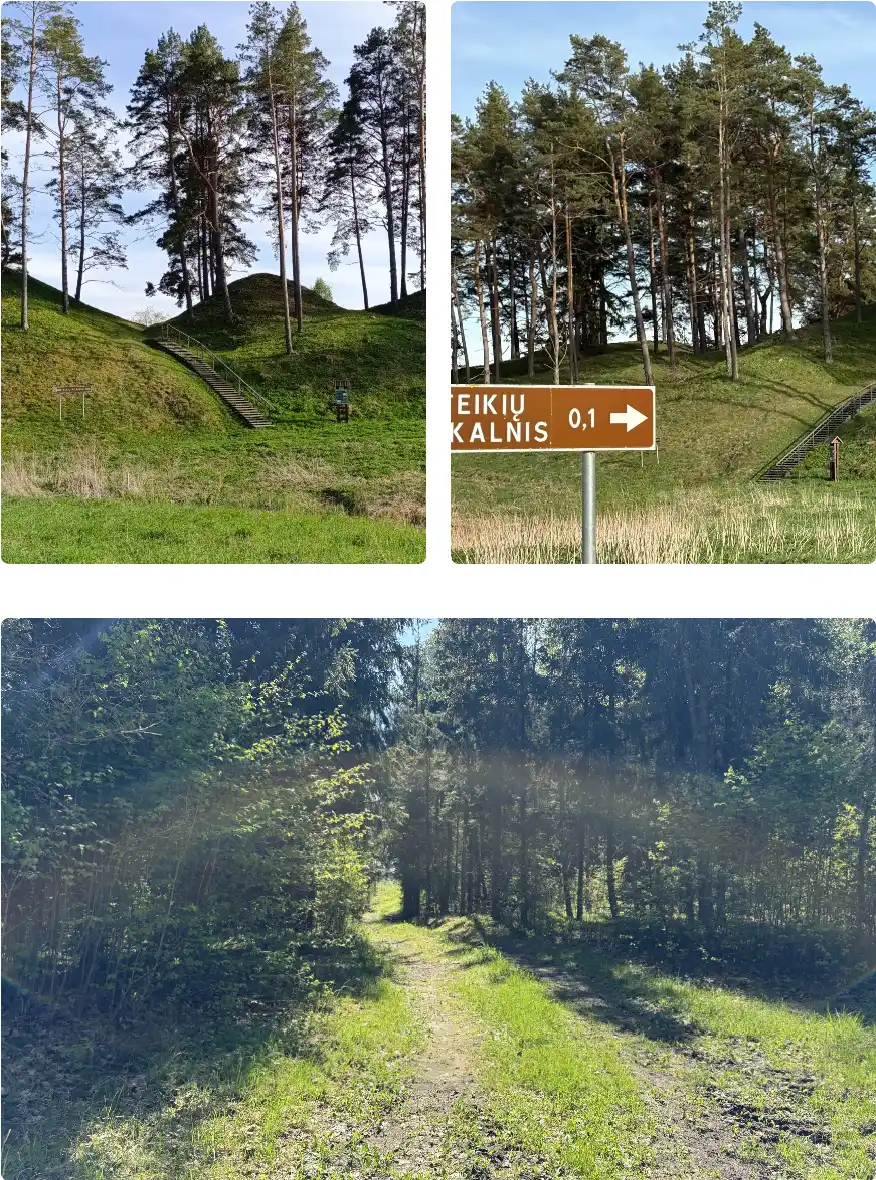
Not only Anykščiai, but also Kurkliai has its own heathland – a forest that pulsates not only with natural beauty, but also with a deep, quietly breathing history. Here, among the mossy hills, lie two 9th–13th century burial mounds with cremation graves, which the locals once called Swedish graves. Like a sentinel near the heathland, the Buteikiai mound stands.
During the years of partisan fighting (1944–1953), the Kurkliai area, and especially the Kurkliai heath, occupied a unique place in the whole of Aukštaitija. At that time, partisan leaders had divided Lithuania into three areas, and the largest of them was the Kalnai, or Aukštaitija, area. It consisted of four districts – Didžioų Kova, Vytautas, Vytis, and Algimantas. And here is what is most intriguing: the borders of all these districts intersected or ran very close to the Kurkliai area. Partisan roads intertwined here, and this could have been one of the most important centers of resistance in the whole of Aukštaitija.
There were several bunkers and hiding places in the Kurkliai forest. The Great Kova District's periodical "Tėvynei šakiant" (The Motherland Calls) was also prepared and printed here.
So if you visit Anykščiai Forest, be sure to visit Kurkliai Forest as well. From a historical point of view, it may be an even more interesting place.
8. Užunvėžiai Church
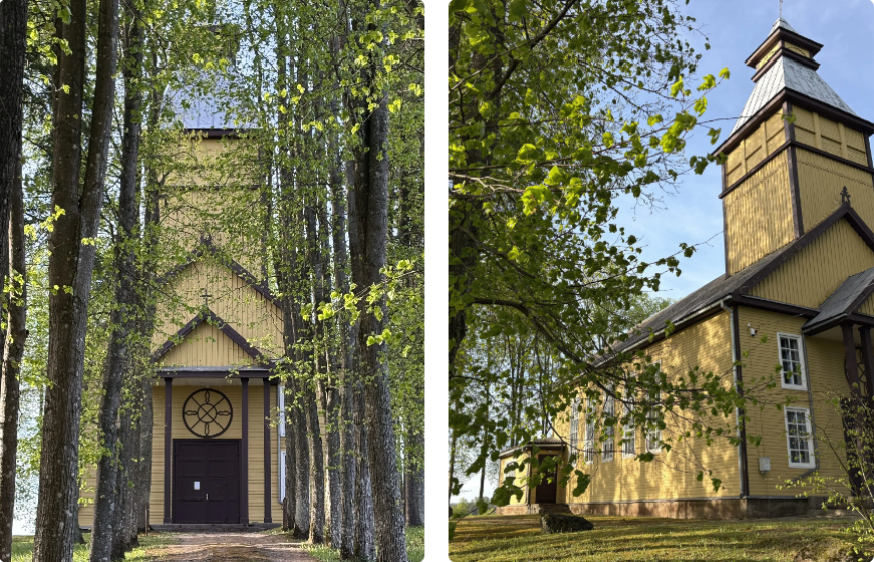
In 1940, a small, ascetic wooden Church of the Holy Virgin Mary was built in the village of Užunvėžiai, Kurkliai parish, complementing the hilly highland landscape with a harmony of modernity and tradition.
In 1938, its design was prepared by the Latvian-born architect and engineer Karolis Reisonas. The single-tower, rectangular-plan church combines tradition and modernity – simple forms and an architectural idea typical of the era. At the same time, another, grand vision of Reisonas – the Kaunas Church of the Resurrection of Christ – was also maturing in Lithuania. However, the architectural spirit, which could not be fully implemented in Kaunas (the Soviets turned the unfinished church into a factory), took on its final form precisely here, in Užunvėžiai.
An avenue of trees leads to the church, like an invitation to stop. The surrounding peace of the fields protects this place from the hustle and bustle. Perhaps that is why Užunvėžiai Church is considered one of the coziest sanctuaries in the entire Aukštaitija.
9. Hometown of the signatory Steponas Kairys
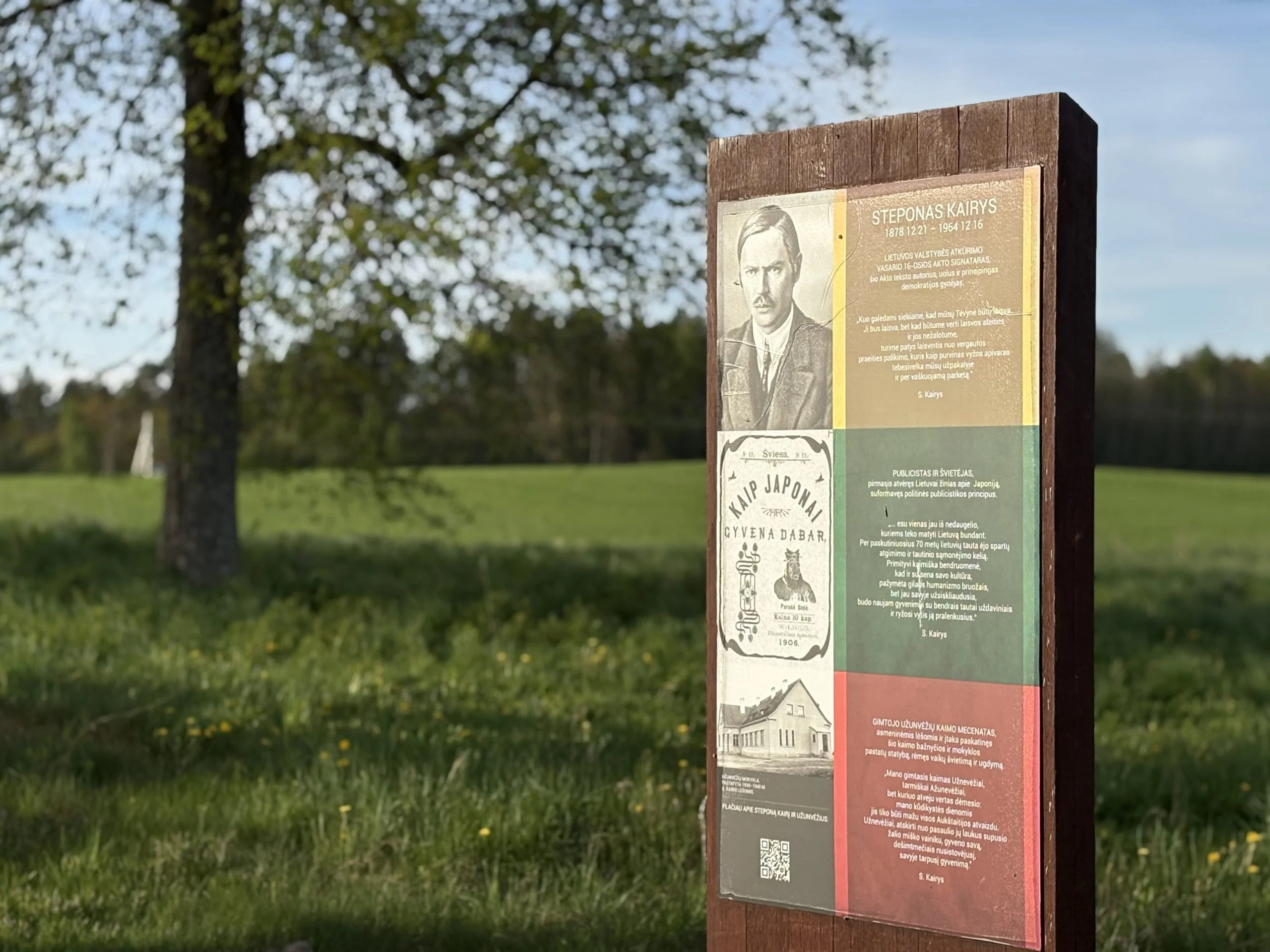
In 1918, Steponas Kairys (1879–1964), a native of Užunvėžys, became one of the signatories of the February 16 Act of Independence of Lithuania. He was a resolute defender of the democratic values enshrined in the Act, a principled Lithuanian politician and social democrat of the interwar period.
Kairys also participated in other important Lithuanian political events of the early 20th century: the Great Vilnius Seimas, the Lithuanian Conference, and the Constituent Seimas. However, Kairys was not only a talented politician. He was also an engineer – a designer of sewage and water supply systems.
Traces of his activities are also evidenced by the former Užunvėžys school, located near his homestead, to which the signatory personally allocated 8 thousand litas in 1939.
It is worth staying longer in the village of Užunvėžiai – it is said that the fields of this region inspire work to strengthen statehood.
10. Kurkliai wooden shrines
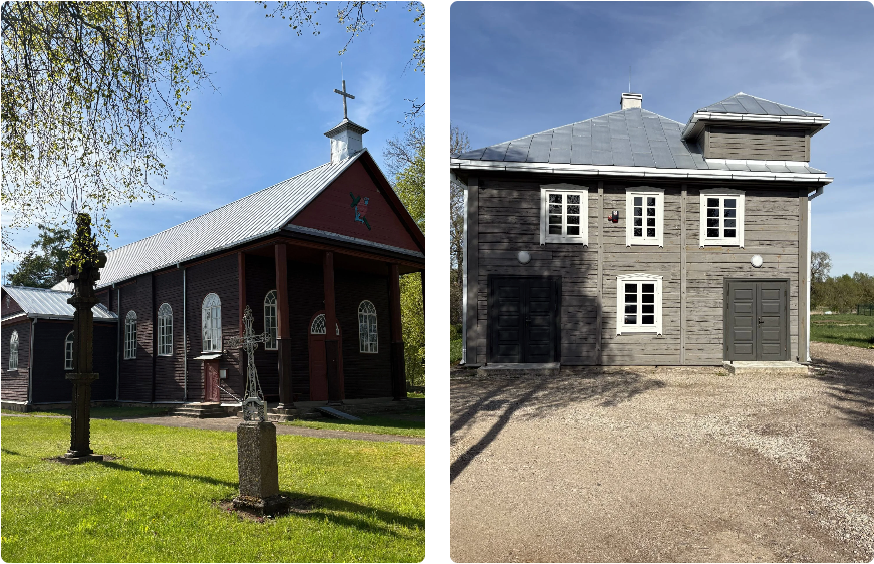
Christian denominations established themselves in Kurkliai as early as the 17th century. The Evangelical Reformed Church, and later the Catholic Church, operated here. In 1700, monks of the Canons of Penance moved to Kurkliai, whose monastery was closed in 1832. Living an extremely ascetic life, they nevertheless accomplished great things: through their efforts, the first school was founded, and the monks themselves earned the respect and love of the local parishioners.
In 1735, the first church was built in Kurkliai, a parish was established at the end of the century, and the current house of prayer has been operating since 1874. St. George's Church and the eye-catching painting of this saint in it became the basis for the town's coat of arms: on a silver background, St. George is depicted on horseback, spearing a dragon.
The history of the Jews of Kurkliai also goes back several centuries. Currently, a Jewish synagogue, built in 1936, still stands here, reminiscent of the times when several hundred Jews lived in Kurkliai. In 1941, the entire community was destroyed by the National Socialists and their collaborators in the Pivonia Forest near Ukmergė. The Kurkliai synagogue is one of the most original in Lithuania. Designed by construction technician Povilas Jurėnas and built near the small Dubėla stream, the wooden structure is one of the few surviving Jewish houses of worship of this type in the country. Today, the synagogue has been reborn in a new form - one of the most interesting art galleries in Lithuania operates here.
11. Angel of the Crows
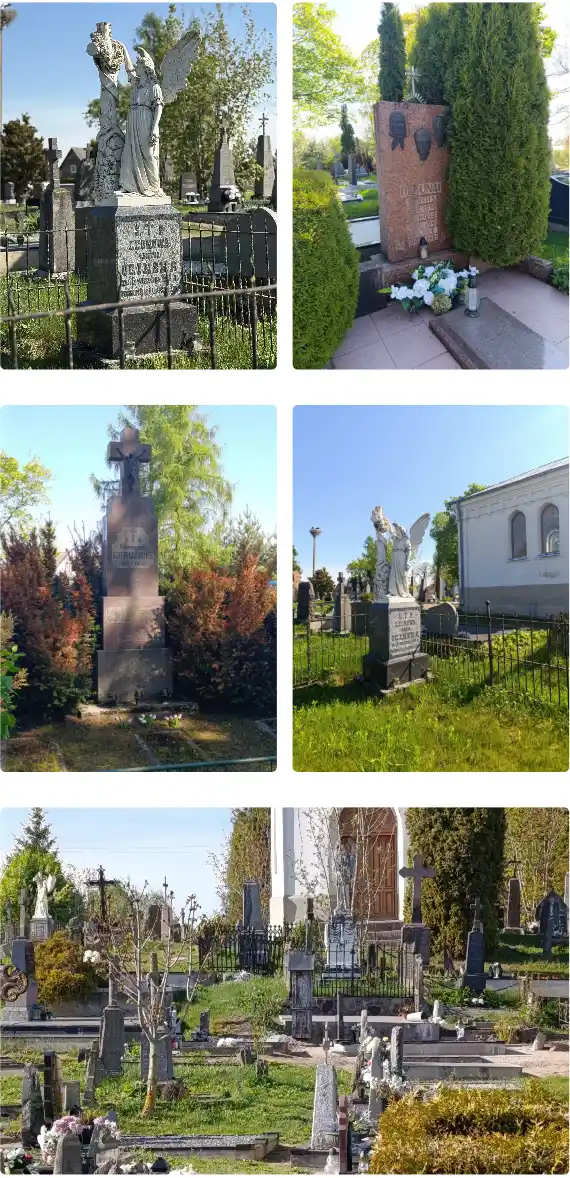
In the old cemetery of Kurkliai, you can feel the breath of almost two hundred years of history. This is evidenced by various monuments, inscriptions on them and the chapel standing in the middle of the cemetery. It is around it that the impressive "old town" of the cemetery has survived - a corner, as if suspended in time, decorated with sculptures of saints and angels, old tombstones, and metal fences.
Here you can also see the beautiful Kurkliai Angel - Leonova Oginska's tombstone. It consists of a stepped pedestal of polished, polished pink and gray granite, and next to the cross stands an angel made of a mixture of ivory-colored cast marble and concrete, holding a flower arrangement in his hands. Like a silent guardian, this impressive angel accompanies everyone walking along the cemetery paths, inviting them to stop, think, and touch the past.
12. Lithuanian statesmen in Kurkliai
In the old cemetery of Kurkliai, close to each other, lie the two most prominent patriots of this region, whose lives and works became an inspiration not only for the town, but also for all of Lithuania.
Jurgis Biliūnas (1888–1950), the long-time mayor of Kurkliai, a relative of the famous writer, was a talented farmer and a far-sighted statesman. His eyes saw America, and his concern for Lithuania's independence even led him to the US president. Unfortunately, during the Soviet occupation, Jurgis was exiled and died in Siberia, leaving a bright mark on the history of his country.
Klemensas Graužinis (1890–1939) – also a talented farmer and businessman – founded a cooperative in Kurkliai, built a modern dairy, and supported the construction of riflemen’s houses. In 1936–1939, he was a member of the Seimas of the Republic of Lithuania. In the summer of 1939, Klemensas Graužinis was unexpectedly killed by lightning. His funeral was attended by the Chargé d’Affaires of the Republic of Lithuania to the Holy See, Kazimieras Graužinis, the Speaker of the Seimas, Konstantinas Šakenis, other Seimas members, ministers, representatives of various organizations, and a large group of residents of the area.
The soon-to-begin World War II and occupations destroyed the works of both patriots, but today the achievements of Jurgis Biliūnas and Klemens Graužinis remain significant and remain an example for the local community, the state of Lithuania, and all who cherish freedom, devotion, and love for their country.
13. Kurkliai meadows and Virinta
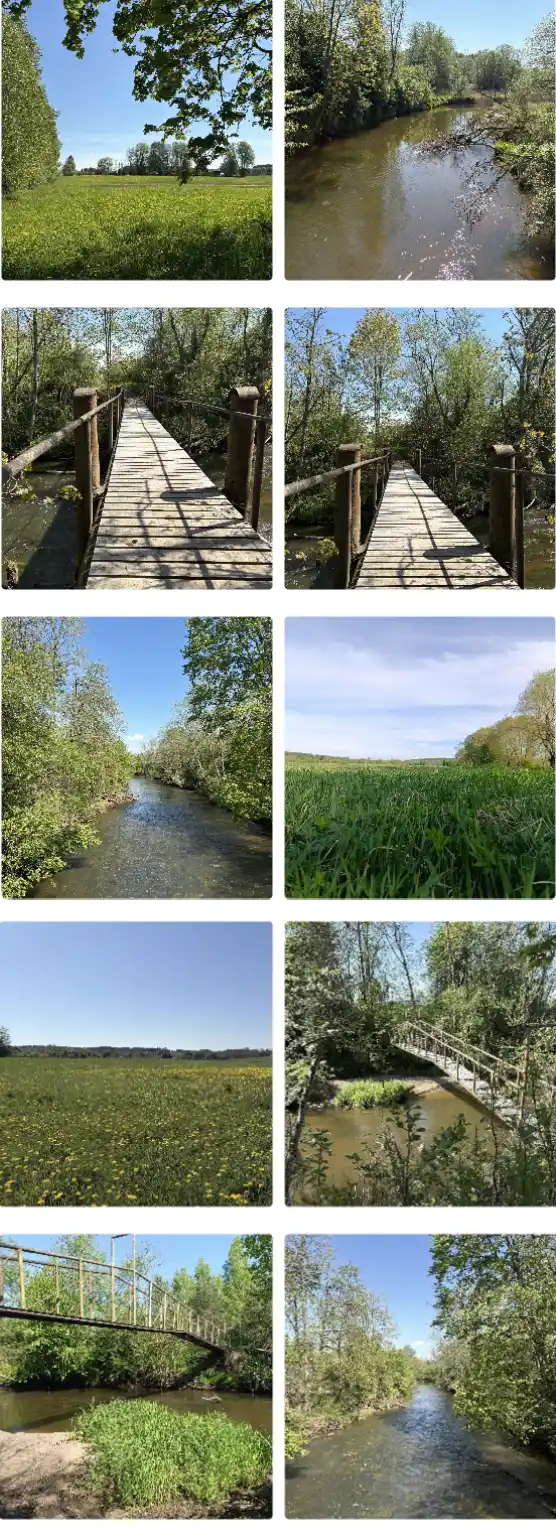
The most fertile lands of Kurkliai have long been located in the meadows flooded by the Virinta River. Perhaps that is why, emphasizing the uniqueness of these meadows, the expression "Kurkliai meadows" has become a part of local folklore. However, this is not just a folklore image - for almost three decades, these shores have been protected in a landscape reserve.
Here, an old river valley with terraces opens up, a craggy, rapid, winding bed. On the banks, sand and clay layers from the Devonian period are visible, as well as white quartz sand from the Neogene period. Trout spawn here, and the meadows are filled with biodiversity and tranquility.
If you want to feel the charm of the banks and meadows of Virinta, take the path from the Kurkliai Synagogue through the meadows until you reach the river. After climbing the iron footbridge, you can watch the rapid flow of the river, listen to its whisper, and think about the unity of nature and man. Just don't make the mistake of telling your friends about this place: Don't call Virinta a stream - Virinta is a river!