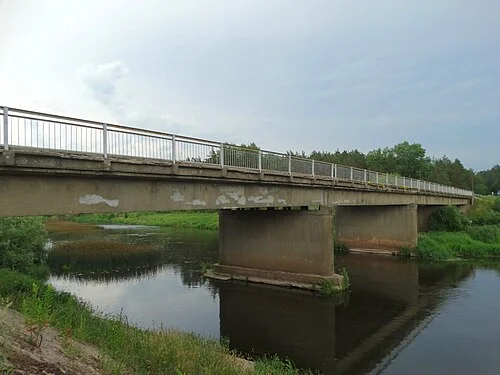
„"13 BRIDGES OVER THE HOLY"“
Tautvydas Kontrimavicius
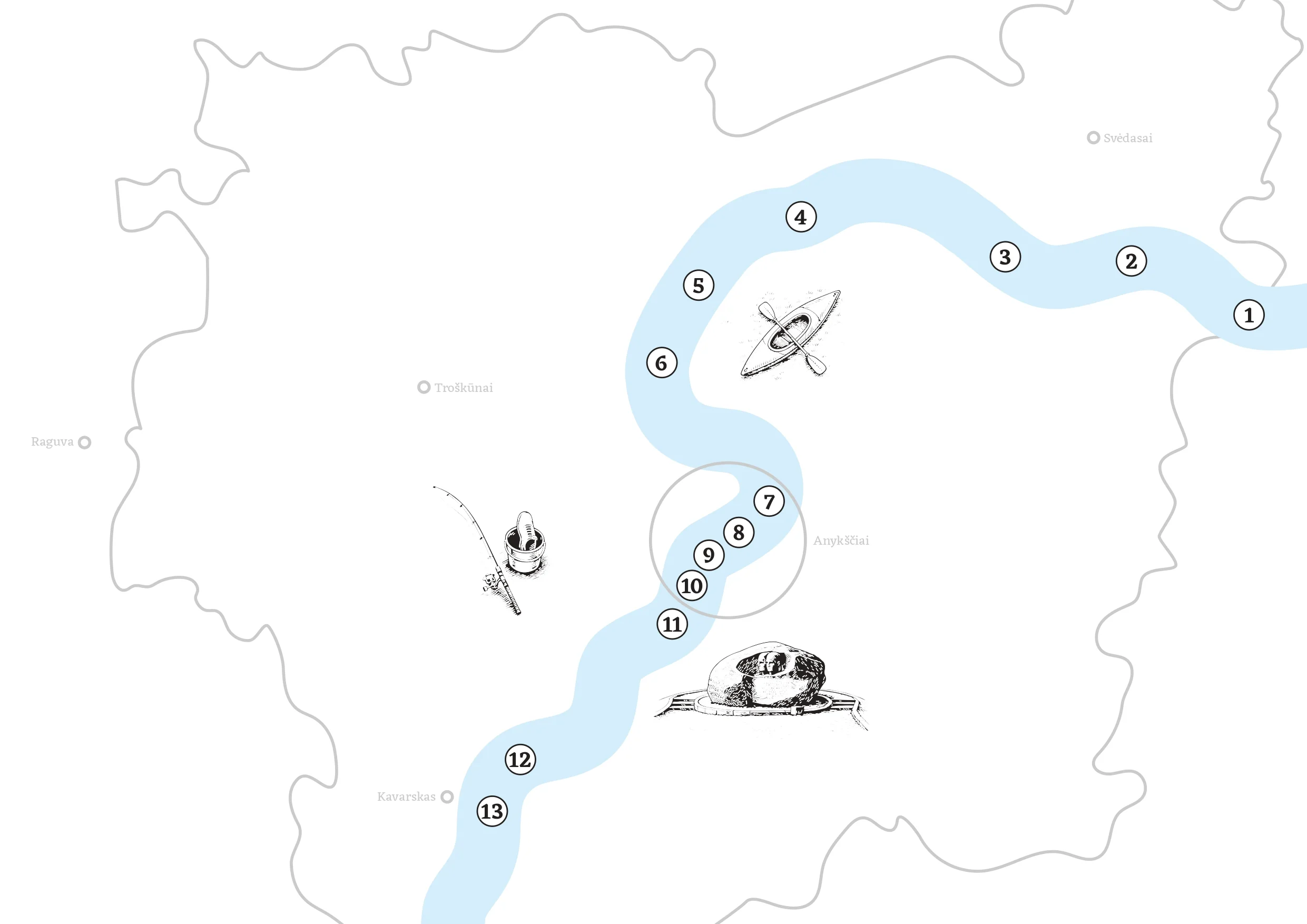
The longest Lithuanian river, the Šventoji, donates a third of its 248 km flow – more than 80 km – to the Anykščiai region, collecting most of the waters of the Anykščiai streams on its way to its bed.
Thirteen bridges can be found on this stretch of the river today. Concrete and iron, swinging over the rapids or leading over dams, they all have the same purpose: to connect the banks of the Šventoji and meet the needs of the people living here.
1. Kunigiškės Bridge
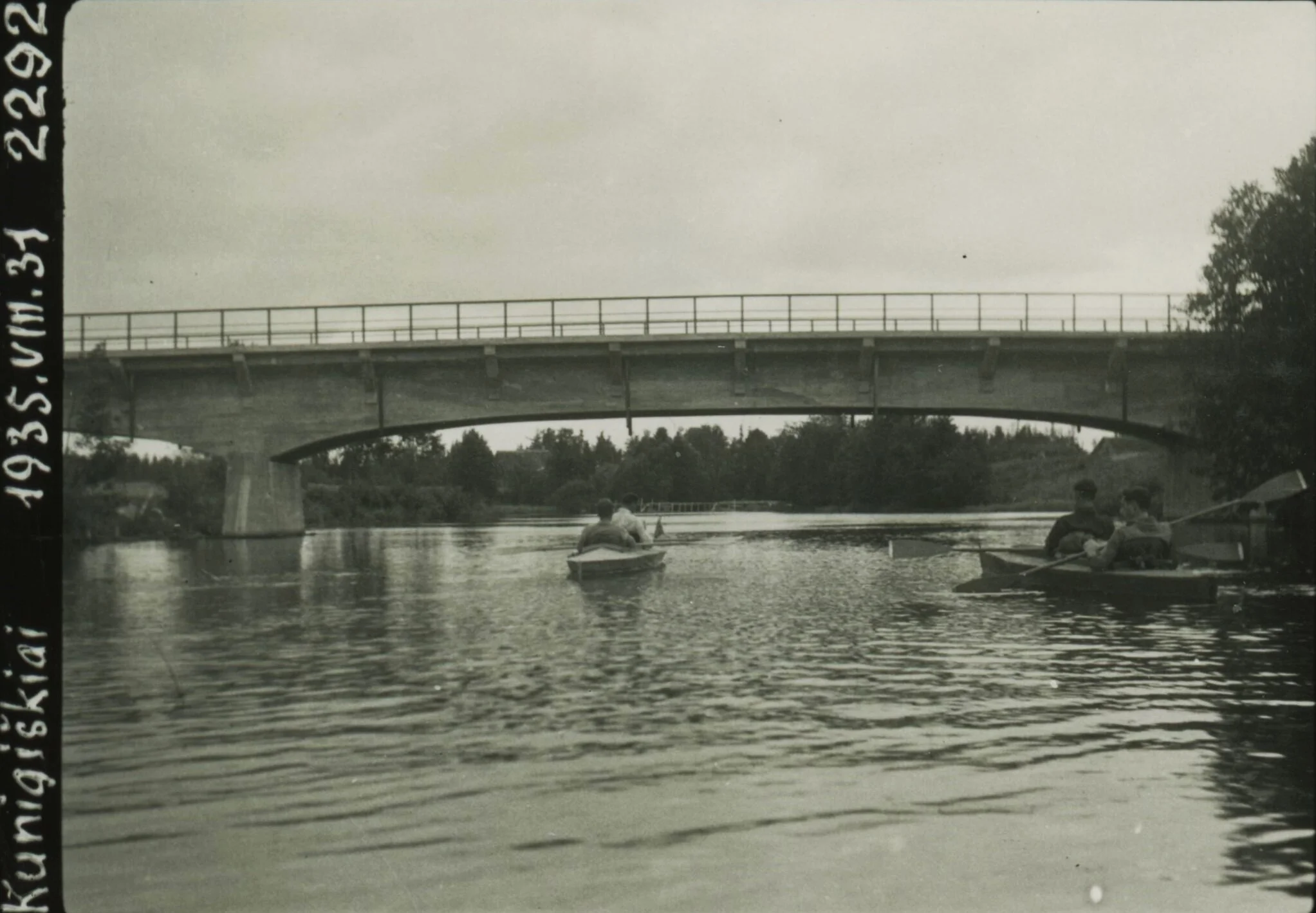
Commemorating the year of the First Independence, the then modern reinforced concrete bridge was built in 1934, during the construction of a more convenient gravel road from the Svėdasai region to Vyžuonas. The initiator of the bridge construction was road engineer Leonas Tuskenis, who came from the nearby village of Vilkabrukiai. Therefore, the structure can be considered his gift to his homeland.
Today it is like a gateway between two districts of Aukštaitija: on one side of the bridge, on the left bank of the Šventoji River, is the Utena District Municipality, and on the other side is the land of Anykščiai.
2. Vaižgantas Bridge
In 1939, a reinforced concrete bridge was erected on the Utena–Kupiškis highway, at Žaliąja. It is younger, but more famous. It was designed by the constructor Pranciškus, who came from Andrioniškis. The bridge was immediately named after the recently deceased diamond canon of the Svėdasai region, Juozas Tumas-Vaižgantas – this is evidenced by the bas-reliefs created by the sculptor Juozas Zikaras, which were removed from the bridge during the Soviet era.
In 2012, the bridge was rebuilt – lengthened to 70 m and widened to 12.5 m, and the restored bas-reliefs on the railings today once again testify to the bridge's honorary name.
3. Mickūnai Bridge
The oldest surviving Šventoji Bridge in the Anykščiai region was built in 1902 near Mickūnai. During World War I, the Germans blew up this first iron bridge in the Anykščiai region, but even the damaged bridge survived.
The bridge was rebuilt by the same Pranciškus Markūnas, a young engineer at the time who would later design the Vaižgantas Bridge. In 1923, the iron structure was covered with a reinforced concrete deck, and in 1963 the bridge was slightly widened. For the second century, it has served those traveling from Anykščiai towards Rokiškis.
4. Mikieriai pier
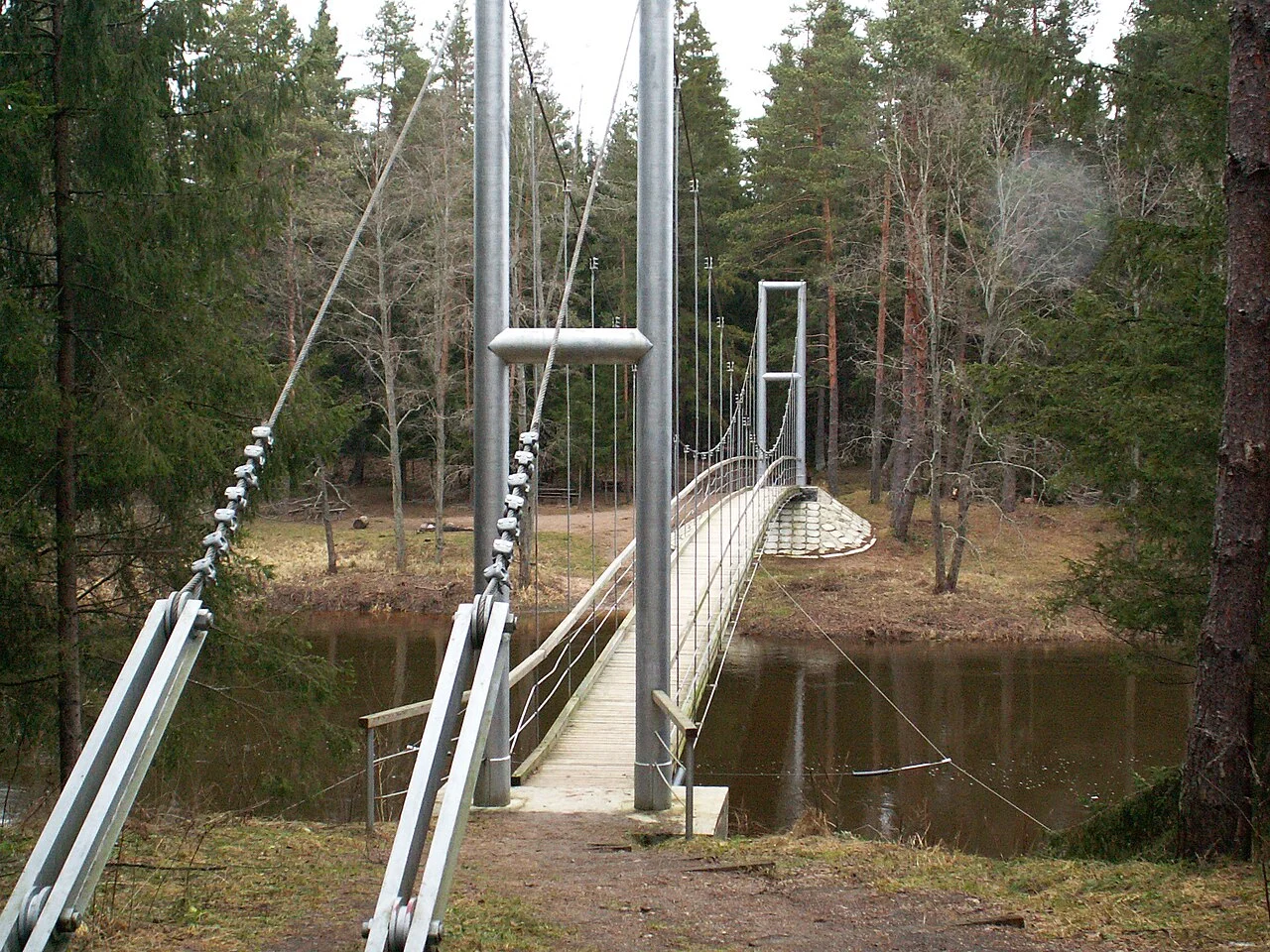
Further on – more than two dozen kilometers downstream, and around – only the forests of Šimonys and Ramuldava, sandy outcrops, reflected in the flow of the Šventoji. And suddenly, like a miracle, a rope bridge for pedestrians hangs and stretches over the river in the forest – from Mikieriai to Inkūnai, to one of the most remote church villages in the region…
The first suspension bridge was built here in 1973, and was mostly used by foresters and forest workers on foot, bicycles, and even motorcycles. When the old bridge began to decay, a sturdy, 80 m long and 1.2 m wide suspension bridge was finally built in the same place in 2002. For several years, it was considered the longest bridge of this construction in Lithuania – until its even longer relatives hung across the rivers.
5. Sedeikiai Bridge
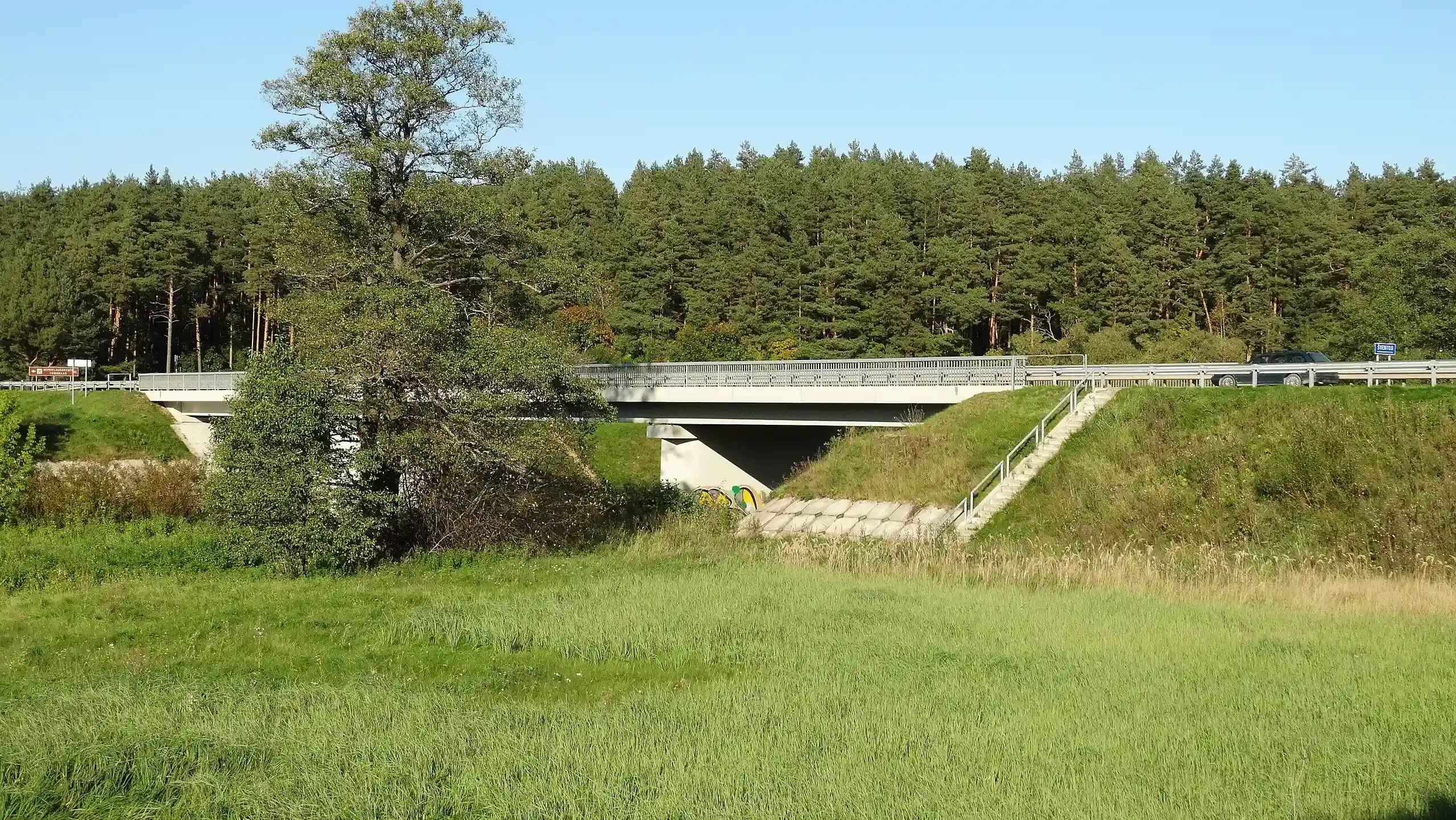
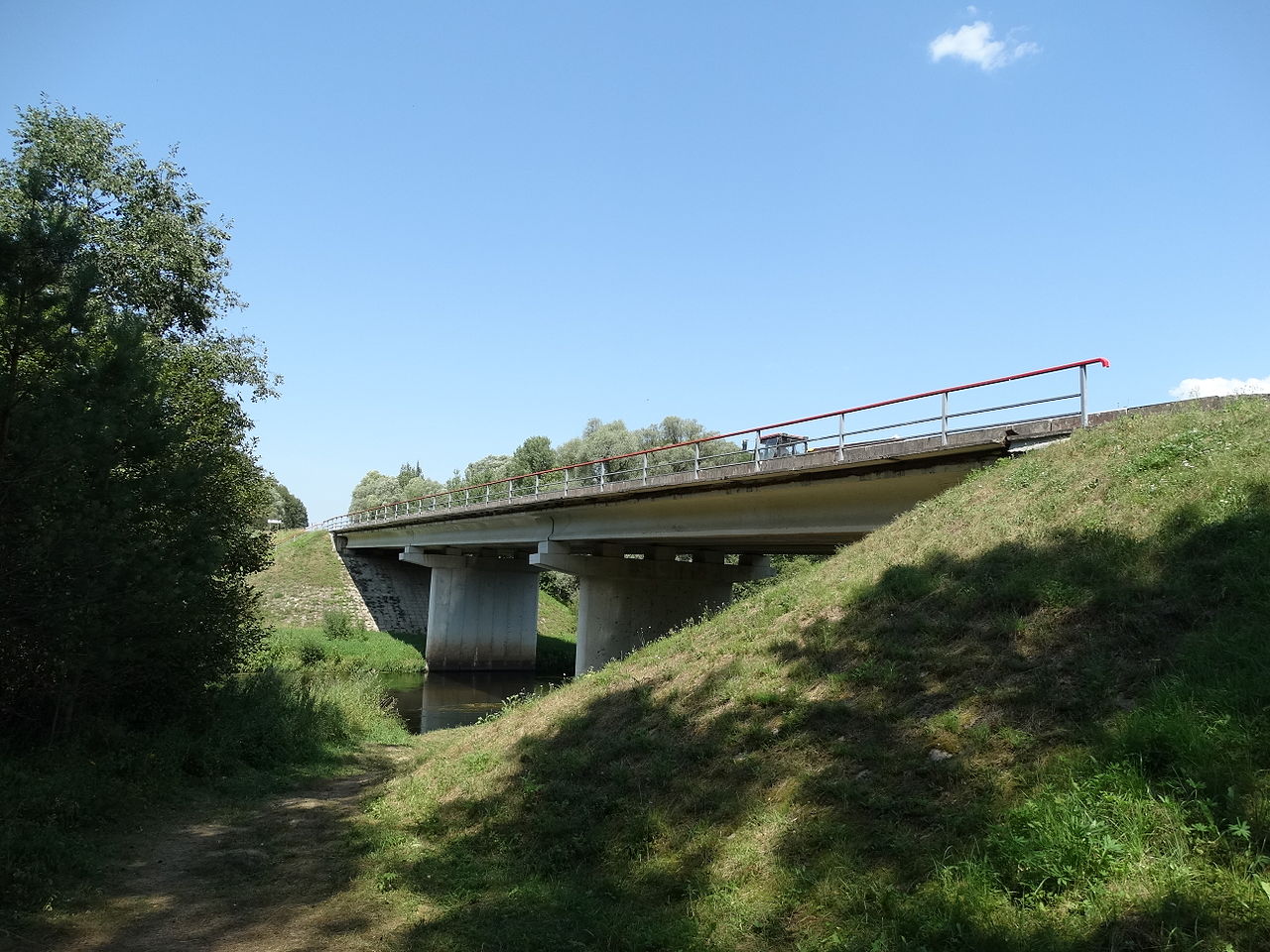
One of the newest and largest reinforced concrete bridges crosses the Šventoji Riverbed at the edge of Šimonys Forest, near the village of Sedeikiai. It was built in 1988 for industrial purposes - to transport sand from the Juodbala quarry to the Kupiškis brickyard via the most direct route.
However, after only a decade, the bridge became almost unnecessary: the sand from the quarry ran out, and its demand in the brickyard decreased, so trucks no longer use this bridge to cross Šventoji. Now the bridge is only important for residents of the inter-village homesteads and mushroom pickers, who use it to reach the boletus growing areas of the Ramuldava Forest more quickly and conveniently.
6. Andrioniškis Bridge
A bridge is simply necessary at the eldership and parish center of Andrioniškis. After the construction of the new and only stone-built Andrioniškis church in the Anykščiai region, in 1941 a wooden bridge over the Šventoji was built next to it.
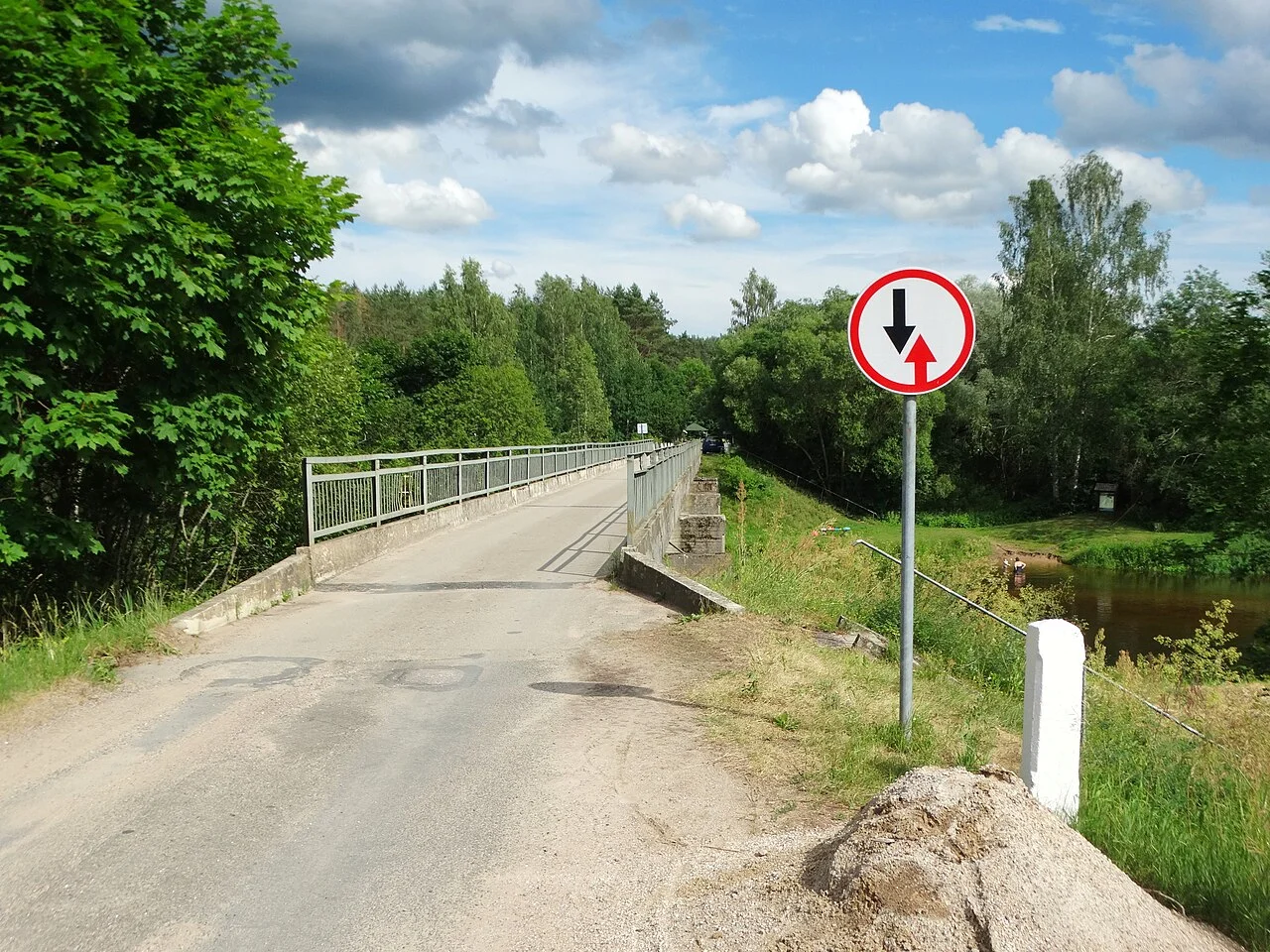
Vytautas Kaušpėdas (1927–2008), who was born and raised near Andrioniškis, across the river, told in his old age how, while working as the manager of the Republican Communications Construction Trust, he was looking for ways to build a normal bridge in his homeland – one that would be convenient to drive to his homestead. Thanks to his efforts, in 1969 a new reinforced concrete bridge was installed near Andrioniškis, which is still in service today. Now the son of the trust manager, Algirdas Kaušpėdas, drives over it to the Kaušpėdai homestead, sometimes with other friends from the "Antie" era.
Despite all efforts, the Andrioniškis Bridge remained the narrowest bridge across the Šventoji River in the Anykščiai region, which can also be used by cars in one direction – its width is only two and a half meters.
7. Narrows Bridge
The city of Anykščiai seems to surround the Šventoji River with a fabric of bridges – in just a couple of kilometers of the river, as many as four bridges are reflected in the flow.
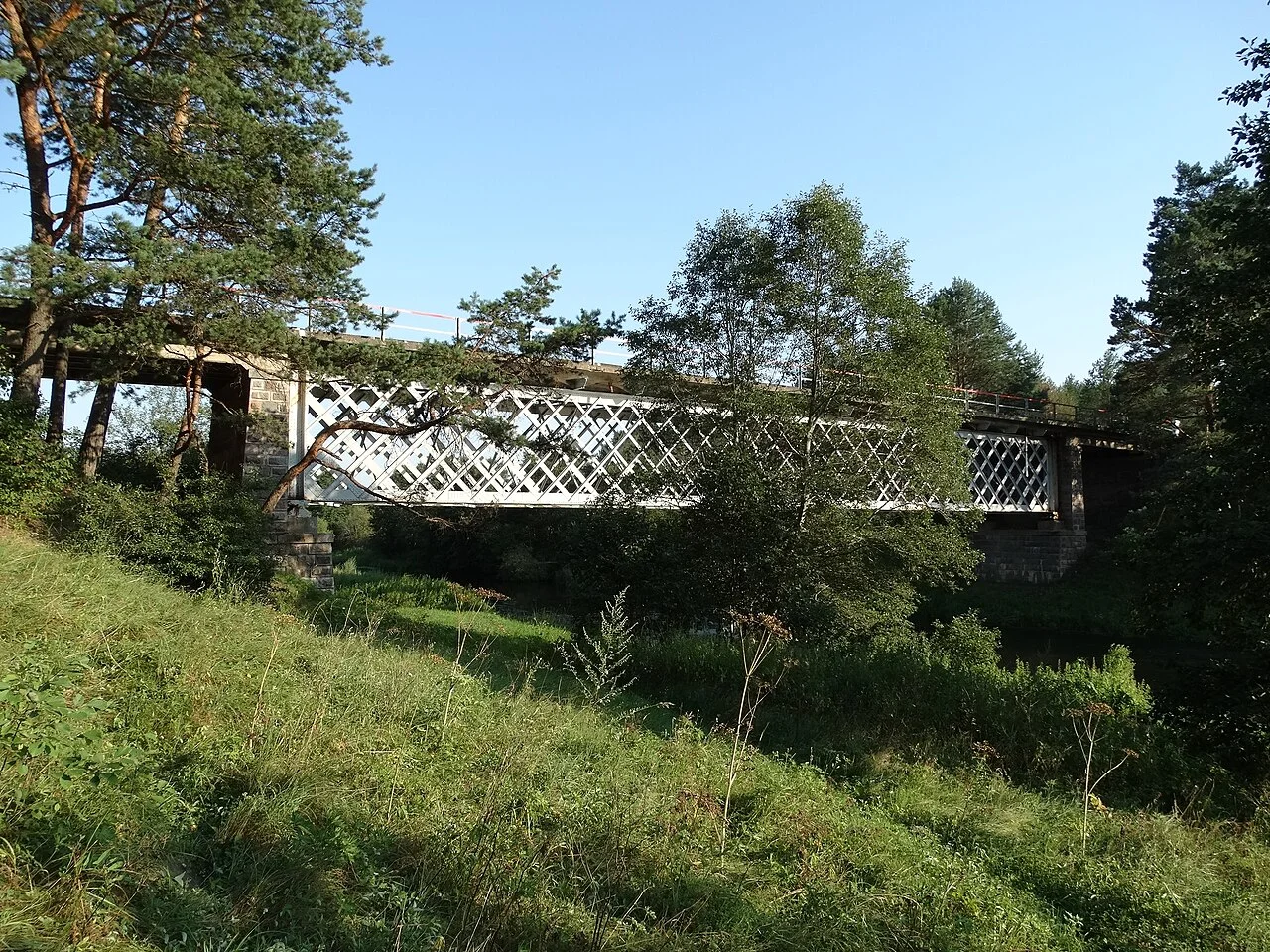
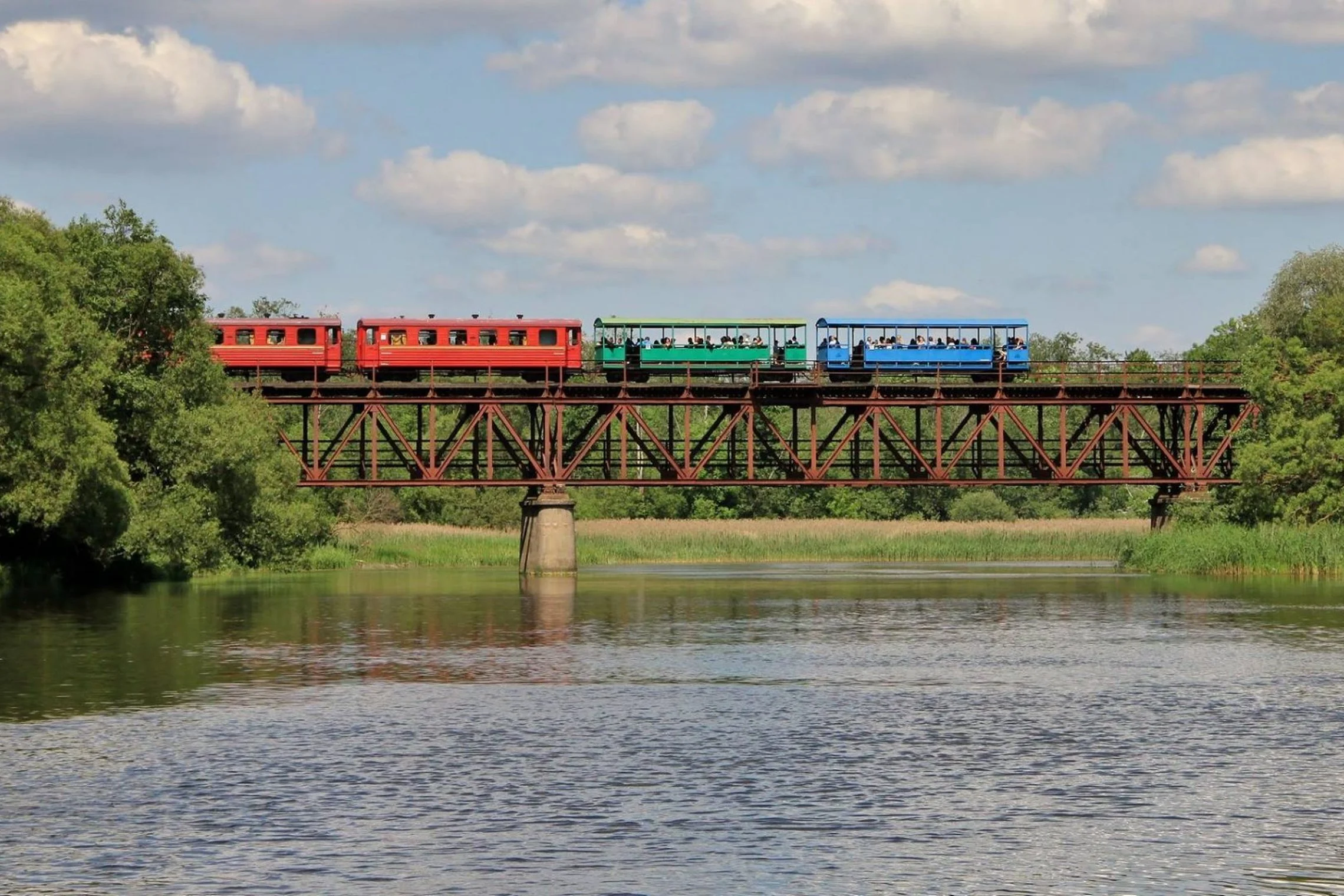
The oldest of them is the 100 m long Siaurukas Bridge, an iron structure built in 1937. It was installed on the site of the first wooden bridge and commemorates the steam locomotives that thundered across the river on rails, and today it accompanies tourist trains rolling along the narrow-gauge railway route.
Although the railway bridge is studded with pedestrian-restraining signs, Anykščina residents often ignore them and use the Siaurukas bridge as a convenient path across the river in the northern part of the city. And young people who do not value their health sometimes take a dip from this bridge into the cool flow of the Šventoji River on a hot summer day...
8. Anykščiai Dam
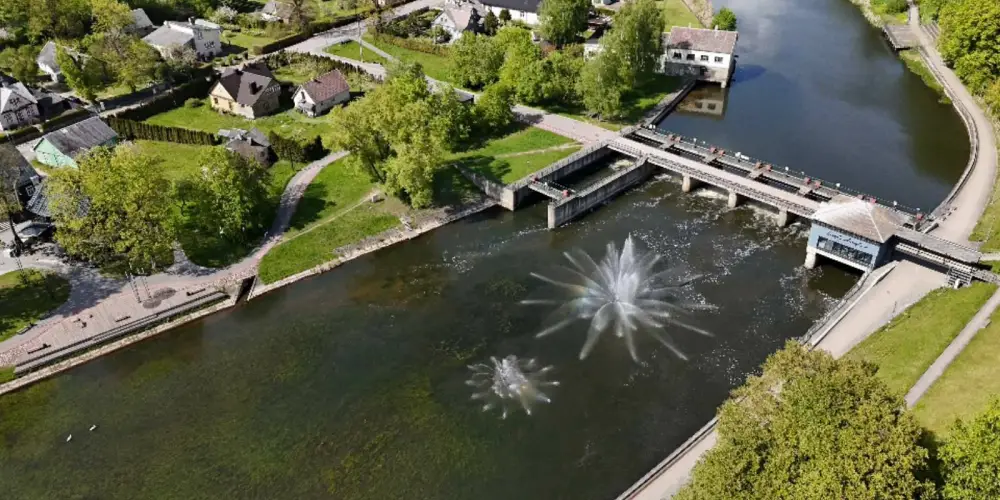
The steps above the Šventoji Dam near Anykščiai have been used for walking since the beginning of the 20th century. When the old wooden dam completely collapsed in the second half of the 20th century, a new concrete dam with controlled gates was built a little further downstream in 1986.
Don't like the fact that the river is dammed? No problem - once the barriers are lowered to the bottom, the water flows freely again, as if there were no dam, and the sturdy reinforced concrete bridge that remains across the river stands calmly in its place.
9. Bishop Antanas Baranauskas Bridge
According to currently known documents, the Šventoji River has been flowing through the banks of the settlement called Anykščiai since 1442. Exactly 350 years will pass before the river starts flowing through the city of Anykščiai in 1792 – when the last king of the Polish-Lithuanian Commonwealth, Stanisław August Poniatowski, grants it city rights and a coat of arms. In the historical coat of arms of Anykščiai, we see not only the Šventoji River, but also a bridge across the river, decorated with a statue of St. John of Nepomuk, the patron saint of bridges and guardian of water disasters.
However, throughout the 19th century, the people of Anykštės failed to build a reliable bridge over the rapid river – they more often crossed to the other bank by ferry. However, the city welcomed the 20th century with its first stronger wooden bridge, which withstood the ice storms of the early 19th century and has survived in old photographs. It served for about two decades – until the First World War.
One of the first works of the Anykštės after Lithuania became an independent state was the construction of a new wooden bridge across the Šventoji. It was erected in the same place where the old one was destroyed during World War I, only this time with a spacious arch in the very middle of the riverbed - so that souls could swim through without obstacles, and ice carriers would not be able to overcome the bridge.
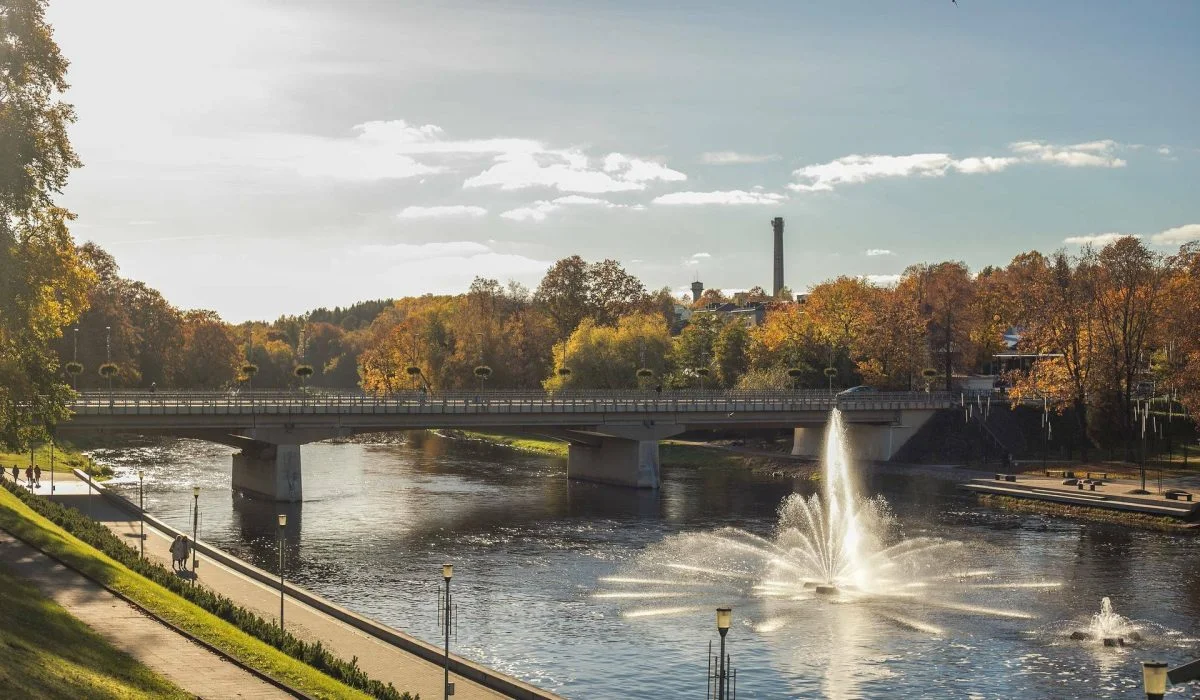
In 1932, a new bridge, built at state expense, connected the banks of the Šventoji River in the center of Anykščiai. The 98 m long and 7 m wide iron arch cost 420 thousand litas. The bridge was ceremonially opened on July 31, 1932 and was immediately named after Bishop Antanas Baranauskas. The residents of Anykščiai believed that finally the banks of the Šventoji River had been brought together forever, and no icebreakers would ever destroy such a bridge again.
The bridge was destined to stand for only 12 years – in the summer of 1944, it was destroyed not by a natural disaster, but by the storm of World War II, taking the name of Baranauskas with it into oblivion...
In the mid-20th century, after the remains of the blown-up iron bridge were removed, a temporary wooden bridge spanned the Šventoji River in Anykščiai for almost a decade. It served until 1956, when a new reinforced concrete bridge was built. The concrete statues installed in its four corners were supposed to testify to the „community of working people“ during the Soviet era – a scientist, a worker, a teacher with a student, and a gardener met on the bridge.
This view of the bridge remained for almost 20 years, until the reinforced concrete bridge began to be distributed in 1974 - an identical new bridge was introduced upstream of the old structure. During the reconstruction, the crumbling concrete statues were removed and remained only in old photographs.
The last reconstruction of the bridge took place in 2006–2007, when the upper carriageway was renovated and widened without changing the concrete supports. The ceremonial opening of the reconstructed bridge was held on July 26, 2007. The most important highlight of the celebration was the return of the name of Bishop Antanas Baranauskas to the bridge after 63 years, and the re-attachment of a commemorative plaque on the bridge.
This bridge not only brings together the residents of Anykščiai living on both sides of Šventoji. It is an indispensable section of the road for everyone traveling from Central Lithuania towards Rokiškis. Šventoji is still waiting for a new bridge – the Anykščiai city bypass.
10. St. John of Nepomuk Bridge
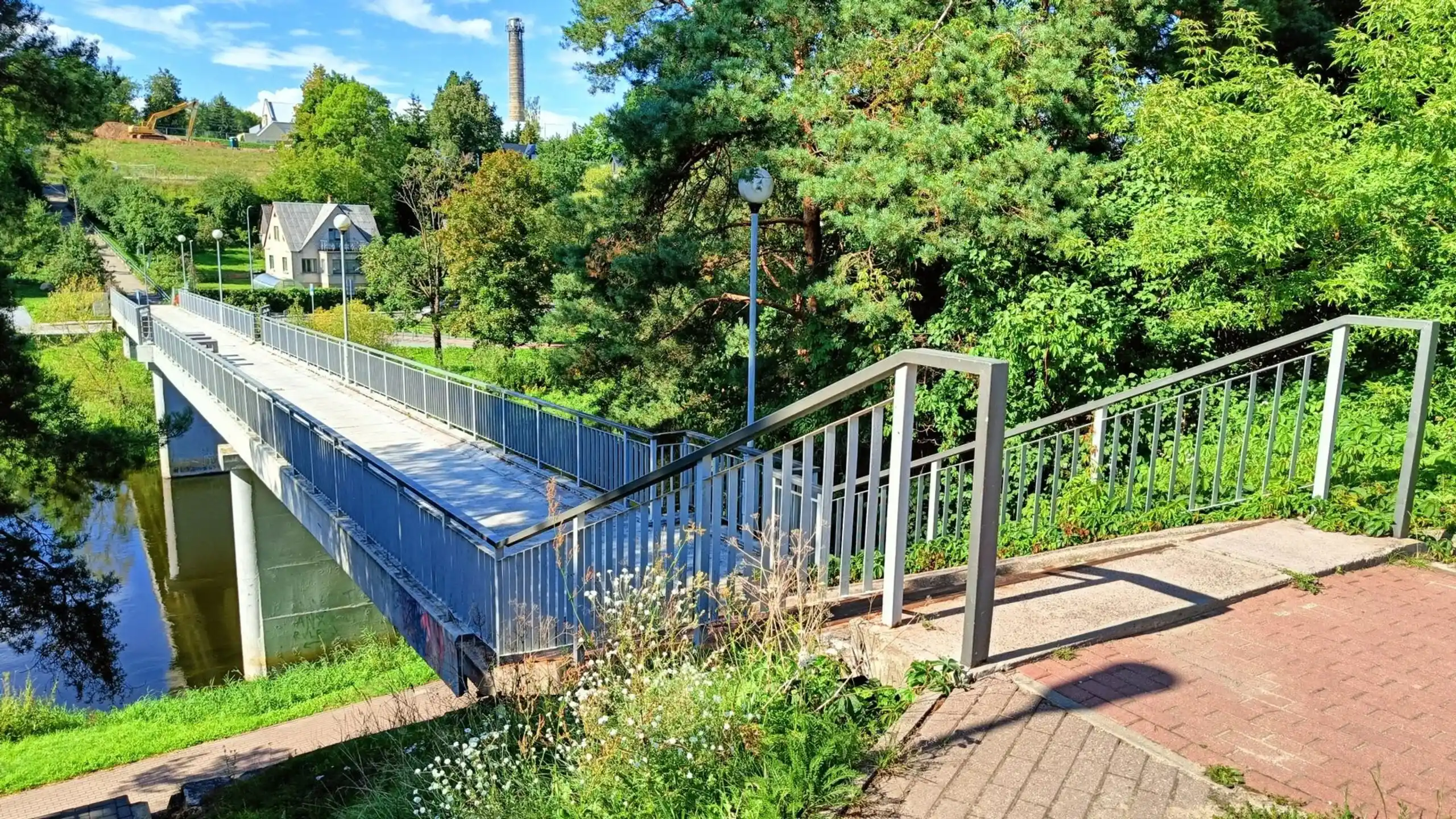
The fourth bridge of Anykščiai city – a 72 m long pedestrian bridge – was built by the residents of Anykščiai in 1998. It was needed to connect the banks of the Šventoji River in the southern part of the city and bring the residents of Anykščiai closer to the recreation and entertainment areas near the Anykščiai grove.
Officially, the bridge is nameless, but the bas-reliefs decorating it remind us of St. John of Nepomuk, the heraldic patron of the Anykščiai bridges.
11. Puntukas pier
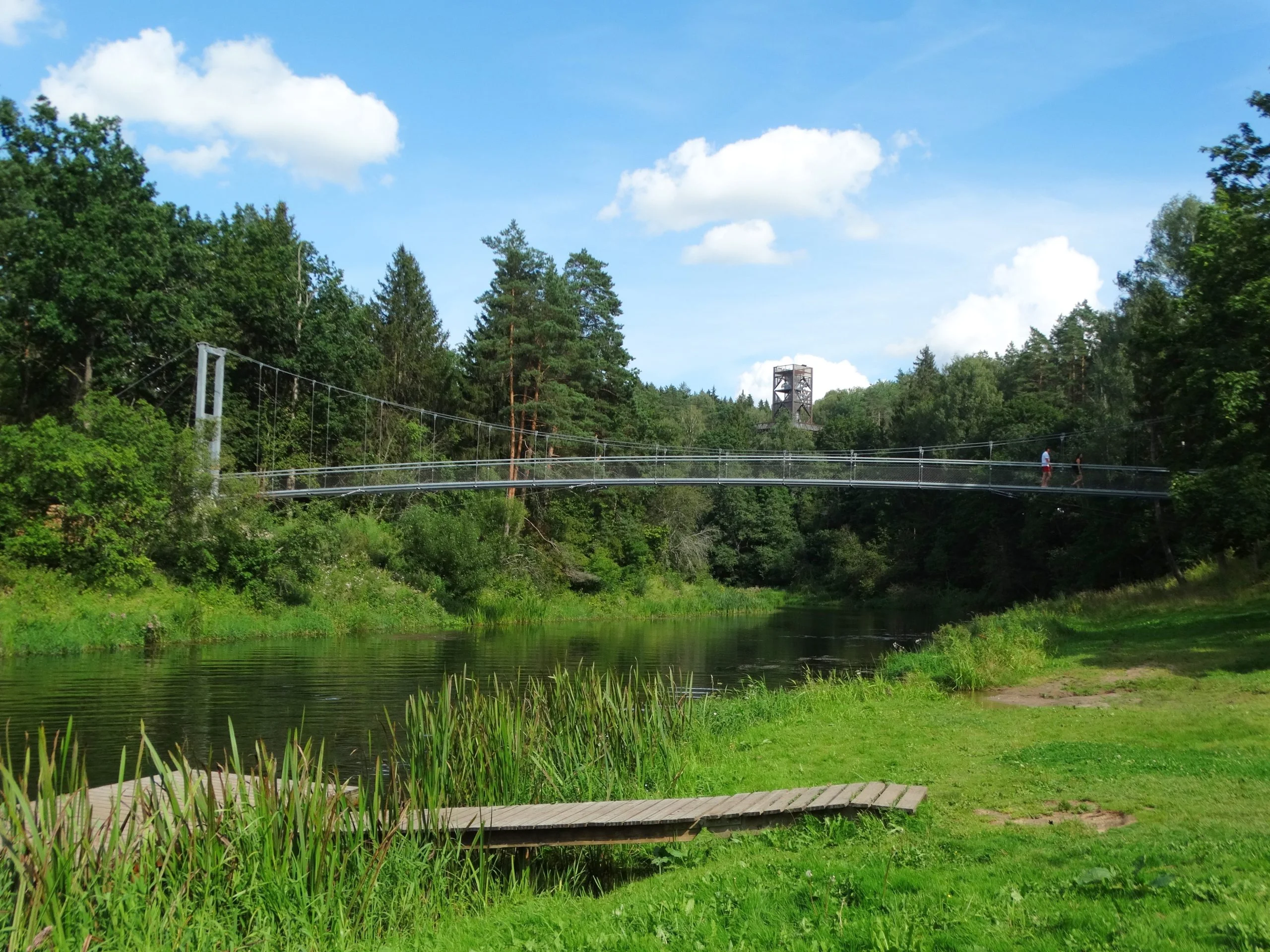
The youngest bridge in the Anykščiai region across the Šventoja River in the village of Puntukas was built – or rather, suspended – in 2020. The Anykščiai šileli rope bridge is intended for tourists and active recreation enthusiasts – pedestrians and cyclists. It connected the villages of Puntukas and Ažuožeriai, separated by the river, opening up new routes around the Anykščiai area on foot or by bicycle.
12. Kavarskas Dam Footbridge
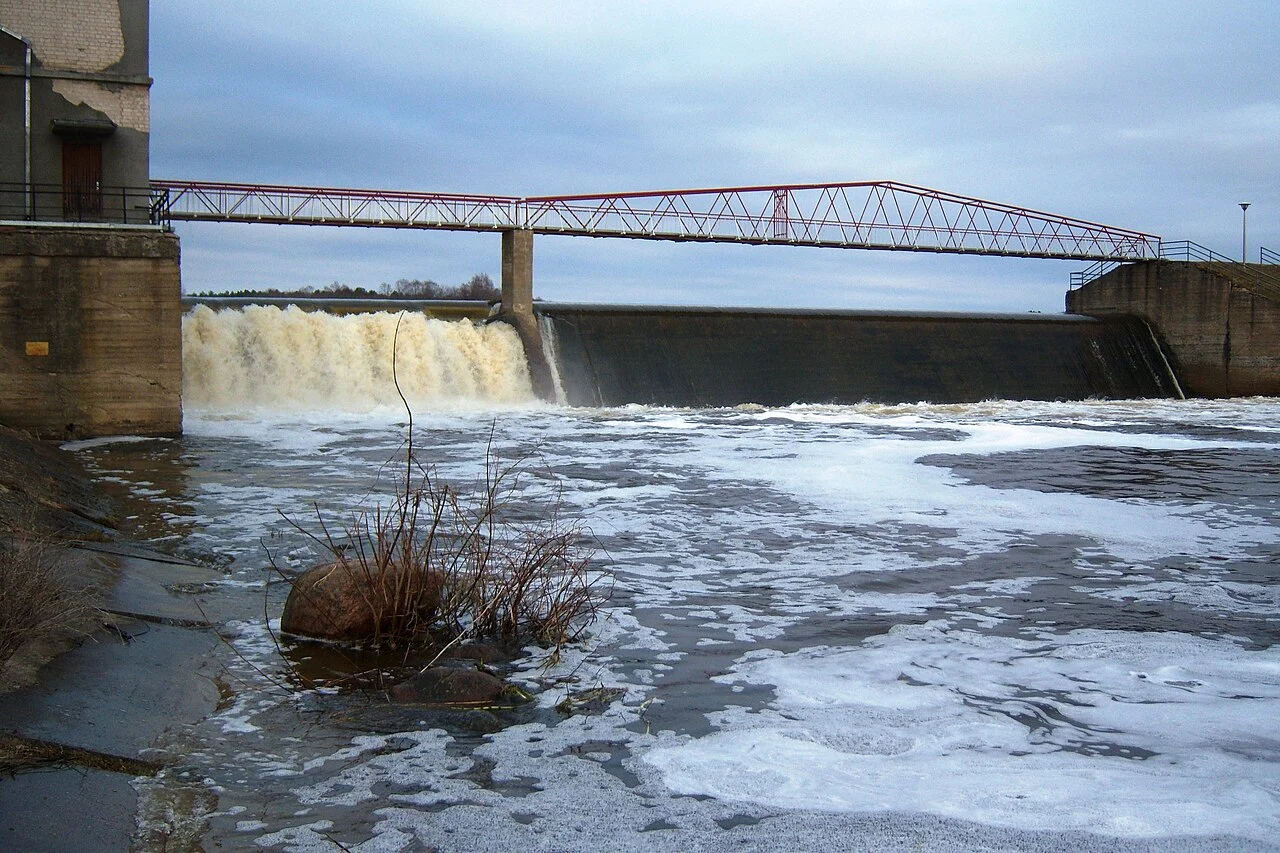
You can also cross the Šventoji River on an iron footbridge near Kavarskas – over a concrete dam installed in the riverbed in 1963. True, walkers are rarely seen here – the footbridge is only important for the personnel servicing the dam and the power plant.
The dam itself commemorates a special Soviet-era idea – to divide water between two river basins. For a third of a century, the flow of the Šventoji from here fed the dwindling Nevėžys, giving it 2–4 cubic meters of water every second. Powerful pumps lifted the water more than 20 m through underground pipes and released it into the formed Pienia Canal, through which it freely flowed towards the Nevėžys. Although with losses, after flowing forty kilometers, the Šventoji water reached Panevėžys, where it was especially needed by industrial enterprises.
As industrial needs changed and the pumping station equipment became obsolete, such water trips were discontinued at the end of the 20th century, but the dam remained useful – the 1 MW Kavarskas hydroelectric power plant was installed next to it and has been operating since 2002.
13. Kavarskas Bridge
The last, 94 m long, reinforced concrete bridge that led the Šventoji River towards Ukmergė has been standing in Kavarsk since 1964 - on the local road towards Kurkliai and smaller villages, patiently awaiting repairs for many years.
Wooden bridges across the Šventoji River at Kavarskas, as well as at Anykščiai, stood at the beginning of the 20th century. In 1915, German cartographers noted on World War I maps that the bridge at Kavarskas really existed, while at that time there was only one railway bridge left in Anykščiai…