The year 2026 marks the 120th anniversary of the birth of the Lithuanian diaspora figure Professor Juozas Meškauskas (1906–2010). This is a good opportunity to remember a man whose life and works left a clear mark on the history of Lithuanian medicine, culture, and diaspora.
Juozas Meškauskas was a physician-therapist, Doctor of Medical Sciences, professor, medical historian and active Lithuanian public figure. He was born in 1906 in Vajėšiai (Anykščiai district), studied and taught at Vytautas Magnus University, and was the dean of the Faculty of Medicine. In 1944, he moved to Germany, later emigrated to the United States of America, where he worked as a doctor and became involved in Lithuanian social and cultural life.
The professor left a significant contribution to the history of Lithuanian medicine. He was an outstanding figure in medical science and education – an excellent specialist in his field, a researcher of the history of medicine, a talented educator, an active press collaborator, and a fosterer of Lithuanian culture.
Although the professor's name is not widely known in Lithuania, his merits to the nation are significant. In addition to his medical and academic activities, he paid much attention to the mobilization of the Lithuanian community abroad, collaborated in the Lithuanian press, supported publishing, and promoted the national and civic education of youth.
For his long-term Christian public activity, in 1987 Pope John Paul II awarded the professor the Order of St. Sylvester - one of the highest and most honorable awards of the Holy See for laypeople. The Order of St. Sylvester (Latin: Ordo Sancti Silvestri Papae) honors individuals who have significantly contributed to the mission of the Church, cultural and social activities, and the promotion of Christian values. This award was rare among Lithuanians, therefore its award to Juozas Meškauskas testifies to the exceptional authority and recognition of the professor's merits.
Religion – a source of light for human life and medicine
Professor Juozas Meškauskas was primarily a doctor, medical scientist and educator, but an analysis of his personal book collection reveals another extremely important aspect of his life – deep religiosity. This is evidenced not only by his articles, public activities or membership in the Ateitinkai organization, but also by the accumulated collection, which his daughter Marija Meškauskas transferred to the Liudvika and Stanislovas Didžiuliai Public Library of the Anykščiai District Municipality. She also entrusted the Anykščiai librarians with the care of her father’s most important award – the Order of St. Sylvester. It is likely that the Order of St. Sylvester kept in the Anykščiai Public Library is the only such exhibit in Lithuania.
J. Meškauskas' personal collection, which was brought back to Lithuania from the United States in 2017, includes 669 books, several dozen periodicals, and more than 300 manuscripts and archival documents.
Religious publications make up about 22 percent of all books stored in the professor's library. This is one of the largest thematic groups in the entire collection. The library has accumulated interpretations of the Holy Scriptures, theological works, books on religious philosophy, publications on Church history, collections of Catholic journalism, and religious literature published in exile.
Various finds preserved in the books allow us to reconstruct not only the circumstances of the formation of the library, but also the professor's relations with Lithuanian clergy and publishers of religious publications. Many publications were purchased by subscription. Subscription forms, publication catalogs, order slips, envelopes and personal letters were found among the pages of the books.
Particularly valuable finds were found in the publications of the book series „Christian in Life“, widely published in the diaspora. They contain documents that allow us to look behind the scenes of Lithuanian Catholic publishing. In Antanas Rubšys’s work „The Key to the Old Testament“ (1983), a letter from priest Vytautas Balčiūnas to the professor, dated 2 February 1984, was found. In it, the author explains in detail the development of the series.
The letter describes the publishing and distribution situation, tells about the administrative changes and difficulties faced by the publishers. In another letter, the same priest introduces J. Meškauskas to the new administrator of the series, priest Jonas Krivickas, and provides facts from his biography and a description of his activities.
These documents are significant today not only for the biography of J. Meškauskas, but also for the history of the entire Lithuanian Catholic press. They testify to the lively cooperation of Lithuanian intellectuals, clergy, and public figures in exile and to their efforts to maintain religious and cultural life in a foreign land.
Religious beliefs are also clearly reflected in the professor's journalistic work. He carefully collected his articles and preserved newspaper issues. On many of them he left handwritten notes indicating the topics of the publications. For example, on the May 29, 1993 issue of the daily newspaper "Draugas" there is an inscription: "On Lithuanian religious life in America", and on the August 31 issue of the same year - "My article about the Pope in Lithuania". Such signs show that the topic of religion was constant and extremely important to him.
The professor’s relationship with faith is perhaps best revealed by his own memories of his departure from Lithuania in 1944. Hastily retreating from the approaching Soviet occupation, he took neither his scientific works, nor his dissertation, nor other professional documents with him. Later, he recalled taking only one book with him – the New Testament. According to him, he did not value any other book as much as these. This fact eloquently testifies to the professor’s value system and the importance of faith in his life.
The inscriptions and dedications found in religious books also reveal the wide circle of J. Meškauskas' acquaintances. One of the most interesting finds is the book "The Great Inquisitor" (1946), donated by philosopher Antanas Maceina. In 1947, the author inscribed a dedication in it: "To my dear friend, prof. Juozas Meškauskas, to remember our common fate of exile." This inscription speaks of the close ties between the two Lithuanian intellectuals, who were linked not only by the experience of exile, but also by common ideals of the Catholic worldview.
Active futurist
Among the publications stored in the J. Meškauskas library, almost two dozen books about the Ateitinės movement stand out. These publications, like many other books of historical and religious content, are dotted with notes, underlinings in pencil and pens of various colors. This testifies not only to their careful reading, but also to the owner's deep interest in the topics discussed. At the same time, these books reveal the professor's special connection with the Ateitinės movement, to whose activities he devoted a significant part of his life.
J. Meškauskas was an active member of the Future Movement. For this activity, the nationalist government imprisoned him in the Varniai concentration camp during the interwar period. He took care of the mobilization of Catholic doctors, founded the Future Student Medical Corporation "Gaja" and was one of its first chairmen. In 1949–1957, J. Meškauskas served as the chairman of the Council of the Future Federation.
While living in exile, the professor maintained contacts with members of the Gaja corporation, worked with the younger generation of future leaders, and wrote about the corporation's activities and its significance for Lithuanian society. The personal library contains issues of the daily newspaper Draugas, in which his articles about the creation and history of the Gaja corporation were published. In one of them, dedicated to the corporation's 35th anniversary, J. Meškauskas wrote:
„The largest number of us arrived in the United States of America. Our number, time and place allow us and oblige us to work. We are exiled from our homeland and we are exiled from place to place in this country as well. There are plants that wither and wither when transplanted, but there are plants that, when transplanted, strengthen their roots and later grow into a stronger and larger trunk. It would be desirable that the „Gaja“ corporation, which is celebrating its 35th anniversary, would not weaken, but would become stronger in all respects and, when it is finally transplanted to Lithuania, could manifest itself with all its capacity for its reconstruction and restoration“ (1). (MEŠKAUSKAS, J. The formation of the Gaja corporation: on the occasion of its 30th anniversary. Draugas, May 25, 1964, p. 7).
According to Z. Danilevičius, Professor J. Meškauskas became a futurist in his youth. While studying at the Ukmergė Gymnasium, he did not limit himself to secondary school knowledge - he consistently
He developed his worldview, read a lot, looking for answers to questions that his teachers did not raise or discuss. Thus, a strong personality of a Lithuanian intellectual and Catholic was formed. The young man's spiritual quest, idealism and desire to serve society eventually led him to the ranks of the future workers' organization (2). (DANILEVIČIUS, Z. Garbinga sukaktis: prof. dr. Juozos Meškauskas 60-tai sukakciai samajėti. Draugas, 1966 m. September 20, p. 4).
Signs left in books
Various marks preserved on the books of J. Meškauskas' personal library allow us to trace the history of their acquisition. Most of the publications were subscribed, some were received as gifts. The library was also supplemented by books published in German in Germany during the war and post-war years.
The findings in the books reveal the professional and personal connections of the library owner. In the German-language book „Lernbuch der inneren Medizin“ (1942) („Textbook of Internal Medicine“), 13 different documents were found: letters in German and Lithuanian, a biography with a photo, and other material related to the activities of Professor Kazimieras Buinevičius. These documents confirm that K. Buinevičius, who did not know Lithuanian well enough, asked J. Meškauskas to rewrite his articles and correct language errors. In one letter, K. Buinevičius also asks to translate his book „Über die Nierentätigkeit“ (1946) („On Kidney Activity“) into English.
The professor's ties with the family of the interwar Lithuanian army general Kazys Musteikis are evidenced by an entry in Stefanija Rūkienė's book "Return to Freedom" (1971). It is known that in Germany, after the Germans expelled the general and his family from a refugee camp, J. Meškauskas would host them for the night in the office of the head of the Internal Medicine Department of a refugee hospital near Munich. (3)Škiudaitė, V. Audronė. The life of Prof. Juozos Meškauskas. Lithuanian Catholic Academy of Sciences Annals, 2007, vol. 30, pp. 157–164.
The library books are also full of other traces of reading – underlining, comments in the margins, passages marked in various colors. All this shows that for the professor, books were not just a decoration on the shelves, but a tool for daily learning, research, and intellectual work.
The professor wrote about the time spent in his library:
„"When I sit in my library and look around my books, they tell me that I have learned a lot from them. And if there is something of mine in those books, it means that deliberation, thinking, decision-making took place. This is the cell of the entire organism of the world. There are trillions - trillions - trillions of such cells. The door of this cell is open. This and that has come out through this door. This cell, with its positive or negative contribution, is in contact with all the cells. In the manifestation, dynamics and decisions of all the cells lies the progress and existence of the world. Let us be dynamic and positively progressive."“
When researching J. Meškauskas's library, it becomes obvious that religion occupied a special place in his life. It was not only an expression of personal faith, but also a moral basis for professional activities, public work, and the fostering of Lithuanian identity in the diaspora. Therefore, the professor's words that religion is a source of light for human life and medicine sound not like a declaration, but like a summary of his entire life's experience and value propositions.
Legacy for Lithuania
The personal library and archive of Professor Juozas Meškauskas, transported from the United States to Lithuania, is today an invaluable cultural and scientific heritage. This collection – the professor’s legacy to Lithuania – opens up the opportunity to learn about the intellectual life of 20th-century Lithuanians, the development of medical science and the cultural ties of the Lithuanian diaspora. Prof. Juozas Meškauskas died on October 21, 2010 in Beverly Shores, Indiana, USA, at the age of 104. His remains were cremated, transported to Lithuania and buried in the Debeikiai Cemetery (Anykščiai District).
In 1941–1944, J. Meškauskas was a professor at the Faculty of Medicine of Vytautas Magnus University and the last dean of this faculty. He was one of the first in Lithuania to start teaching gastroenterology. During the interwar period, he published medical works „The Problem of Diabetes and Its Treatment in the Present“ and „A Diet of Green Fruits and Vegetables in Internal Diseases“.
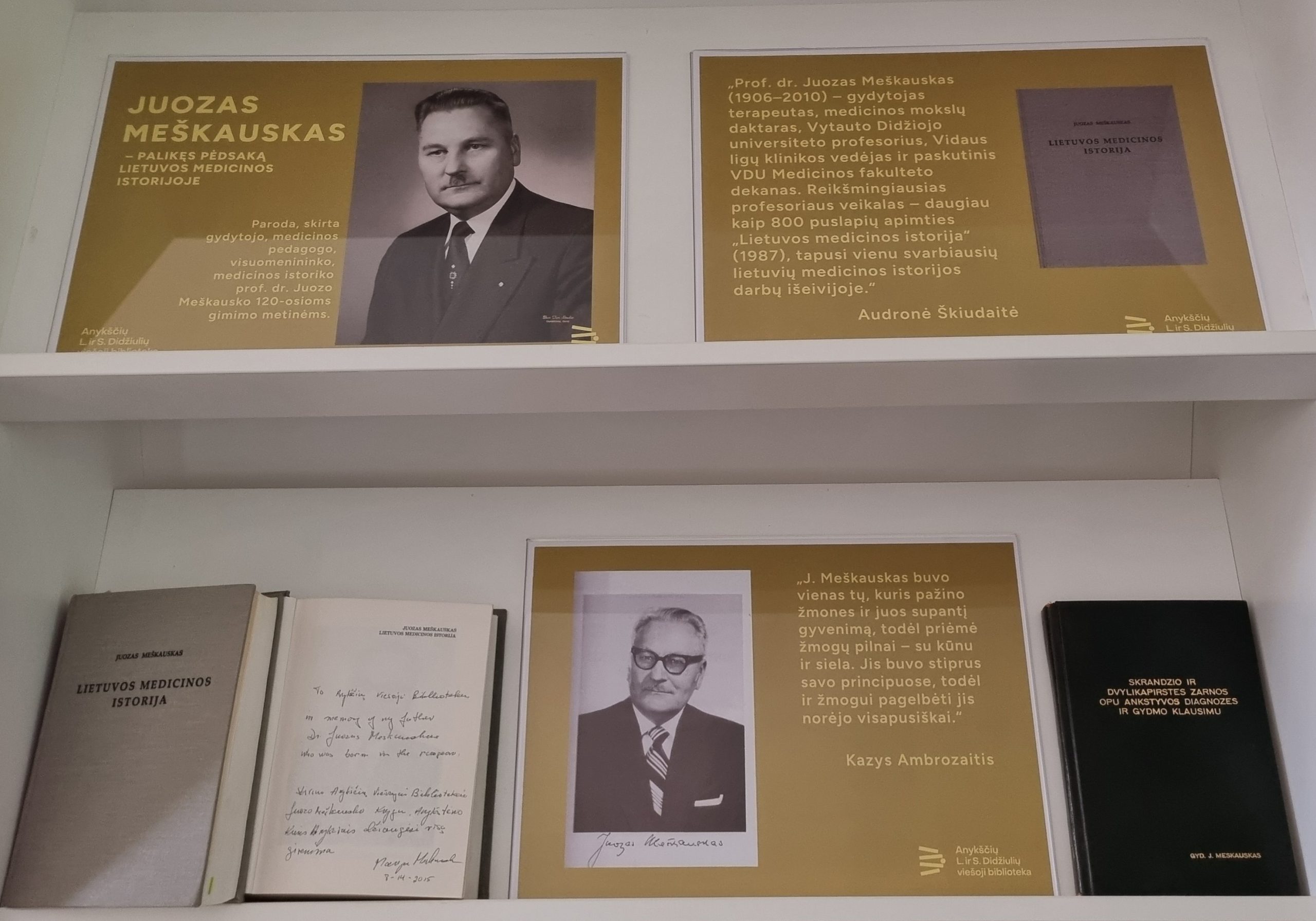
One of the most significant works of the professor was the monumental study „History of Lithuanian Medicine“, published in 1987. This work is still considered one of the most important studies of the history of Lithuanian medicine. The publication of the book in the diaspora received a wide response – it was discussed in detail in the Lithuanian diaspora press, emphasizing the lasting value of this work. This is reflected in the article of prelate Juozas Prunskis „Tribute to Prof. dr. Juozas Meškauskas“ („Draugas“, April 14, 1987, p. 4) and in the review of Juozas Kriaučiūnas „Hello, History of Lithuanian Medicine“ („Draugas“, April 16, 1988, pp. 1–2).
During his lifetime, Juozas Meškauskas published hundreds of articles on topics of medicine, history, religion, and society. Even at the age of one hundred, he actively collaborated in the Lithuanian press.
A special place in his works was occupied by reflections on the relationship between religion and medicine. The professor wrote: „Religion and medicine have a lot in common. It can be said that both disciplines grew together. <…> Religion and medicine have to do with the same object – man. For both religion and medicine, man is very complicated, intricate. The doctor knows more about the material side of man, and the clergyman – about the spiritual. The doctor and the clergyman must be the closest collaborators, because they complement each other. It is now clear that we cannot treat the human body while ignoring his spiritual world.“ (3) “Meškauskas, Juozas. The Importance of Religion in Treatment [manuscript] – Cambridge, Ohio, December 1956. – Anykščių L. and S. Didžiulių Public Library Manuscript Fund, F. 35.)
Remembering the professor, Kazys Ambrozaitis wrote: „There are people who know people only in one respect, there are people who know both people and life. J. Meškauskas was one of those who knew people and the life around them, therefore he accepted a person completely – with body and soul. He was strong in his principles, therefore he wanted to help a person comprehensively.“ (4) AMBROZAITIS, Kazys. Medicine is both science and art: Dr. Juozas Meškauskas – 85 years old. Draugas, 1991, July 23, pp. 3–4.
This year, as we commemorate the 120th anniversary of the birth of Professor Juozas Meškauskas, we remember not only a talented physician, scientist, and educator, but also a person whose accumulated spiritual and intellectual legacy remains significant for the history of Lithuanian science and culture.
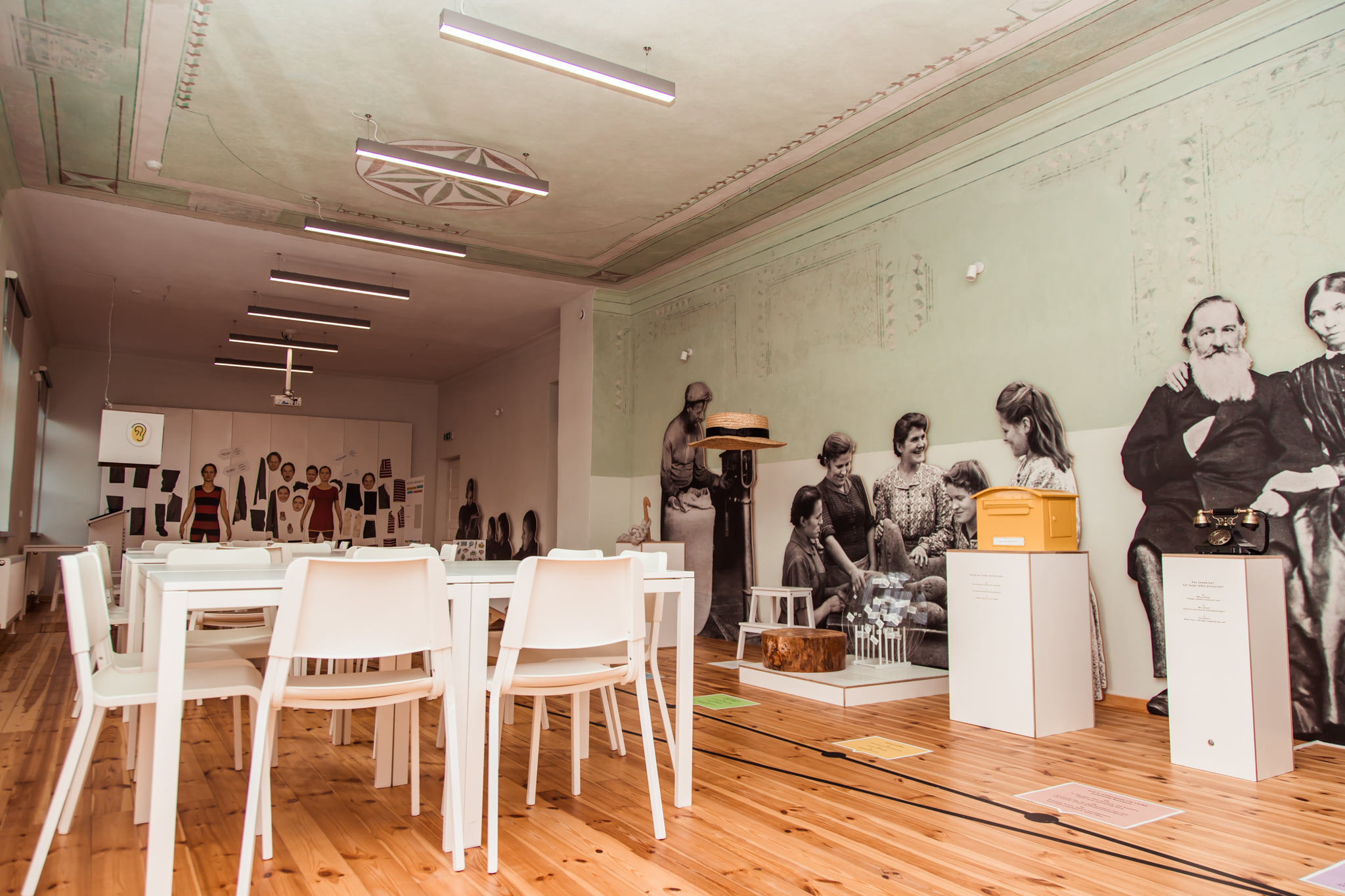
We invite you to visit the exhibition „Juozas Meškauskas – who left a mark on the history of Lithuanian medicine“ prepared by the Regional Documents and Local History Department of the Anykščiai Public Library. It displays books, manuscripts, photographs and other documents from the professor’s personal library and archive, which returned to Lithuania from the United States. This legacy, preserved and entrusted to the library, is today a valuable source for researchers and everyone interested in the history of Lithuanian medicine, culture and emigration.
The exhibition will run from June 26 to August 31, 2026.
Audrone BEREZAUSKIENĖ
Anykščiai L. and S. Didžiuliai Public Libraries
Head of the Regional Documents and Local History Department